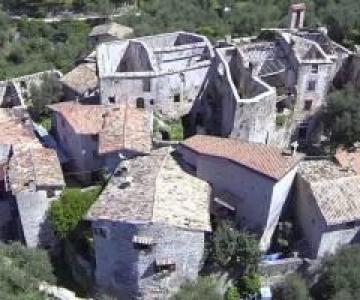
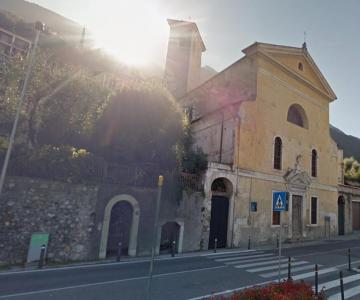
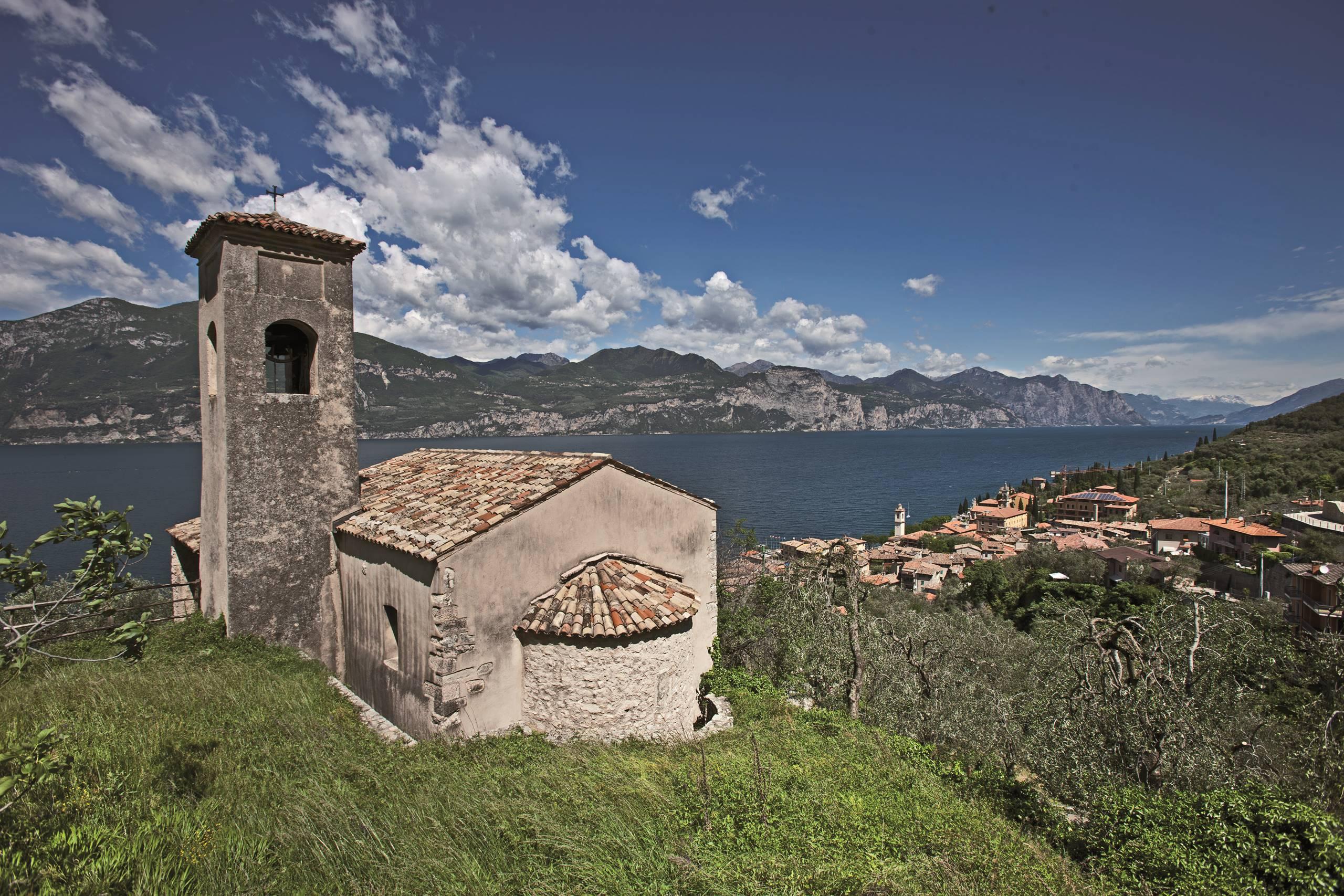
The church of San Nicola in Assenza was built around the 11th-12th centuries as an expression of the worship of Saint Nicholas, the bishop of Myra, who is invoked against the dangers of the waters, and it is already documented among the chapels of the parish of Malcesine in a deed of 1159 by Pope Adrian IV. The appearance of that church must have been quite different from the current one, and while we now have only a few traces, we can imagine it similar to many other Romanesque chapels scattered across the lakeside area, with a gabled facade, a single nave, and a semicircular apse. It must have been extended eastward and still in the 15th century westward, and enlarged on the south side in line with the projection of the bell tower.
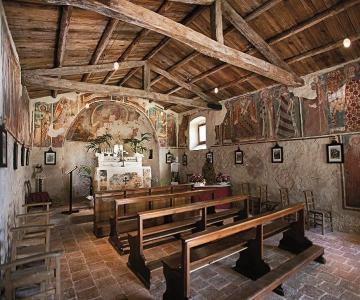
The facade was later renovated in modern times with a window and door in neo-Gothic style. The interior, marked by two 15th-century Gothic arches, is a single nave that narrows, at the height of the bell tower, into a rectangular choir. Here stands the main altar and the beautiful 16th-century altarpiece depicting the Virgin with Child and Saints Nicholas and Anthony Abbott; a second altar, erected in the 18th century in honor of Saint Francis, is placed against the southern wall and holds an altarpiece representing Saint Francis in the act of receiving the stigmata.
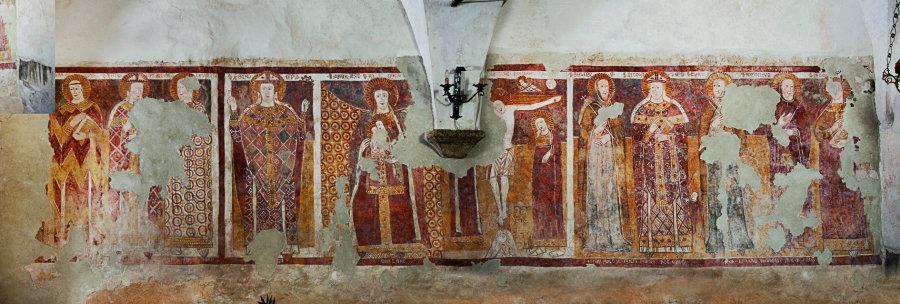
Along the northern wall, a small lateral entrance, dating from the Romanesque period, led to the adjacent small cemetery. The roof of the nave features exposed trusses, while the choir is covered by a double ribbed vault with Gothic sails. Finally, the interior walls retain painted panels executed respectively around the end of the 13th century (a fragment of the Last Supper on the northern wall) and in 1322, as noted near the figure of Saint Michael at the beginning of the northern wall, at the top. The 14th-century panels depict along the northern wall from west to east: The Flight of the Virgin of Mercy and a part of the cloak; Saints Michael and John the Evangelist; Saint Martin and the beggar; Saints Stephen, Saint Zeno, and Bartholomew; Saint Zeno; Saint Anne, the Virgin, and James the Greater.
On the southern wall, after the restorations of 1998, became visible again, from east to west: The archangels Michael and Gabriel and Saint Bartholomew; Saint Lucy. Finally, on the semi-pendant of the second arch, a panel from the end of the 15th century or early 16th century features the images of the Virgin enthroned with Child among Saints Catherine of Alexandria and Lawrence.
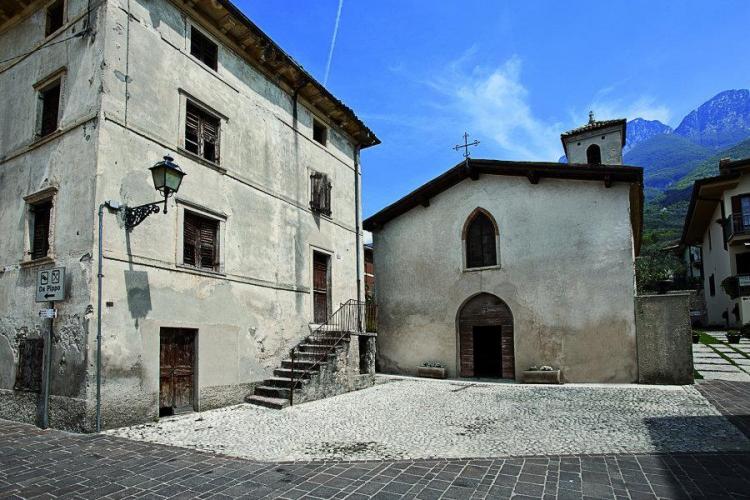


Chiesetta di San Nicola
Via Zanardelli, 38 , Brenzone sul Garda - 37010
- Contacts
- tel. (0039) 0457420076
- email info@brenzone.it
- fax (0039) 0457420758
- web http://www.brenzone.it
TAKE ME HERE: Via Zanardelli, 38