In April 1949, Italy joined the Atlantic Pact, and consequently, it was decided to restore the fortifications located on three defensive lines: the Yugoslav border, the Isonzo River, and the Tagliamento River. The construction of "permanent fortifications" began, which had previously been prohibited by the Peace Treaty of 1947.
Starting in 1950, small-scale positions were built across the territory, organized in various orders and adapted to the new tactical requirements for defending sensitive objectives. They were designed as a stably organized complex of armored positions with a high stopping power and a single command. In fact, they generally consisted of a command post with an observation point (PCO), a complex of armed positions with machine guns (M), and anti-tank gun positions (P). The "command and observation post" directed the defense and was connected to a "radio bridge" system.
The unit designated to guard the installation was the "stopping company," composed of a commander, a command and service platoon, consisting of two squads, a works garrison platoon, a close defense platoon, and a medic. The fortification had to face defensive actions against motorized, armored, airborne troops, and sabotage units; later, the advance of mechanized infantry supported by armored units was anticipated. Thanks to underground construction, personnel vulnerability was significantly reduced even in the case of nuclear explosions. Over time, the "permanent fortification" became increasingly vulnerable due to the increased accuracy of weapons and the strategic need for greater mobility. The fall of the "Berlin Wall" and the dissolution of the Warsaw Pact eliminated the assumptions that had generated it. Starting from 1991, the stopping units and disarmed and demobilized works were progressively disbanded.
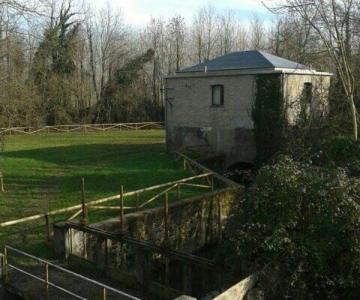
The "fortification work located on the banks of the Tagliamento River," in the municipality of San Michele al Tagliamento, was built at the end of the 1960s to defend the bridge on SS 14 and the Venice-Trieste railway line.
A particular note is that it is the only work of the stopping infantry in the Veneto region, as well as the southernmost among them. The defensive line extended to the north and south of the right bank of the Tagliamento River. The work featured, in its final configuration, six machine gun positions in a turret with four loopholes, two armored vehicle positions, and a command-observation post.
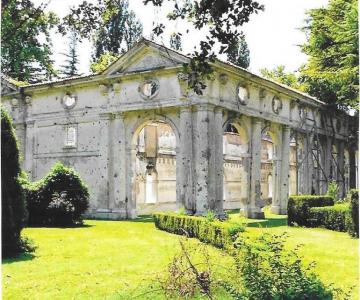
In the area of the bunker, up until World War II, Villa Zuzzi stood.
The construction dates back to 1890, designed by Architect Raimondo D’Aronco from Udine, who won the competition for the decoration of the façade of the First Italian Exhibition of Architecture, where the project for Villa Zuzzi was also exhibited.
In 1941, the villa underwent renovation by the Udine architect Pietro Zanini, who had worked in D’Aronco's studio in the 1920s.
During World War II, its position between the vehicular bridge and the railway bridge, considered strategic targets by the German and later American aviation, led to its destruction: Villa Zuzzi was bombed in the air raid of May 19, 1944, which devastated Latisana and leveled San Michele al Tagliamento, now known as San Michele Vecchio. On the night of December 24, 1944, an additional four bombs fell on the ruins of the villa, which had already been hit multiple times by successive bombings until April 30, 1945.
During the reconstruction in the post-war period, the area where Villa Zuzzi stood became marginal and fell into a state of abandonment. Historical events, urban planning issues, and the reconstruction of San Michele Vecchio resulted in a distortion of the site where Villa Zuzzi was located, making it no longer traceable.
Today, remnants of Villa Zuzzi include the entrance gate, an erected column, and a fragment of a column scattered on the slope of the hill in the topsoil that formed during the construction of Cold War bunkers in the 1960s, no longer placed in the original site. These are two natural stone artifacts, laid in rustication. A comparison with period images shows that the columns are missing the decorative elements placed as a top finishing.
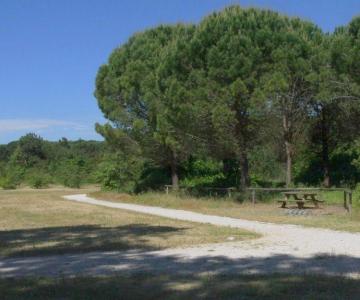
The external area of the bunker, which also includes information panels, is always accessible as it is located in a public park.
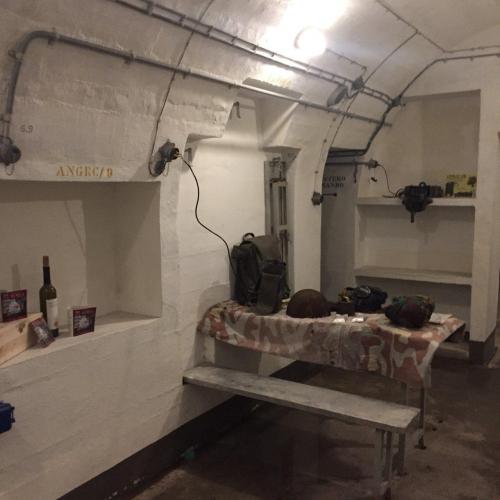
The internal area, furnished with period objects, is visitable during the free guided tour of the historical-cultural itinerary "The Wars of the '900".