The palace that the noble Iseppo Porto decided to build, around the mid-1540s, in place of a previous late Gothic residence, stands towards the northern end of contrà Porti, not far from the site where, a few years earlier, his brothers-in-law Marcantonio and Adriano Thiene had embarked on a grand renovation project of their urban residence.
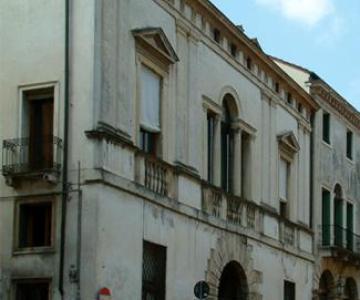
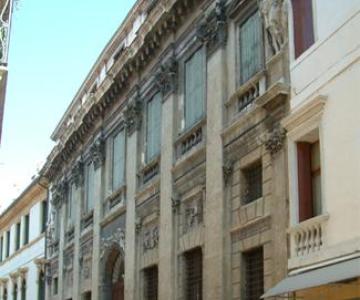
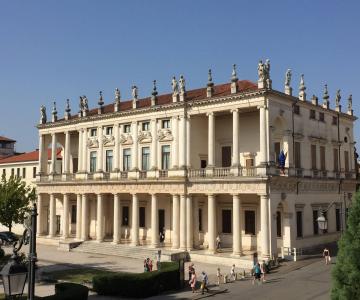
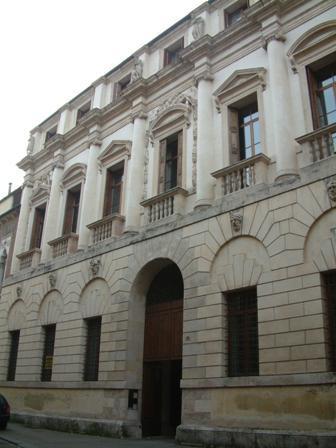
It is a two-story building with an overlying attic, accessed through a remarkable atrium with four columns covered by a cross vault.
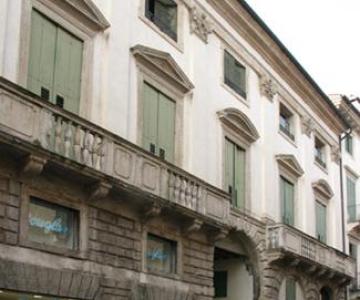
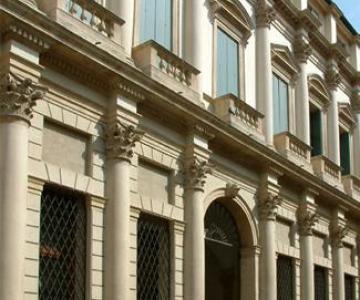
The ground floor, configured with soft rustication, features three rectangular windows under lunette arches on either side of the portal, with masks in the keys; the noble floor is punctuated by Ionic semi-columns in seven bays, with just as many arched windows with alternating pediments, overlooking slightly protruding balconies enclosed by balustrades. On the attic floor, square windows open between pillars; on the two central ones and on the end pillars, there are honorary statues of the Porto family.
The Palladian authorship of the design is supported by its inclusion in the Quattro Libri and by several drawings in the R.I.B.A. collection in London, which critics have linked to studies and design hypotheses for the palace.
From these sources, it is deduced that the palace was to consist of two symmetrical wings facing the streets, contrà Porti and contrà Stalli, between which a large square courtyard with a peristyle of giant columns was to be situated; of this project, only the wing on contrà Porti has been realized.
The Palace constitutes one of the first Palladian realizations in the city completed after the initial Roman stays; its effects are recognized in the influence of Bramante’s vision, particularly in the use of the so-called Raphael House scheme, with the architectural order superimposed on the rusticated ground floor, and in a more grandiose and monumental conception compared to earlier examples like Palazzo Civena, particularly manifested in the atrium with four columns, which Palladio employs here for the first time, and in the unrealized idea of the porticoed courtyard with the giant order, which shows evident references to ancient Roman architecture and Michelangelo.
The chronological framework of the intervention has been quite debated, but recently the genesis of the project has been placed around 1546. The realization appears to have been largely completed in 1549, while completion works, including internal decorations, are documented up to 1552.
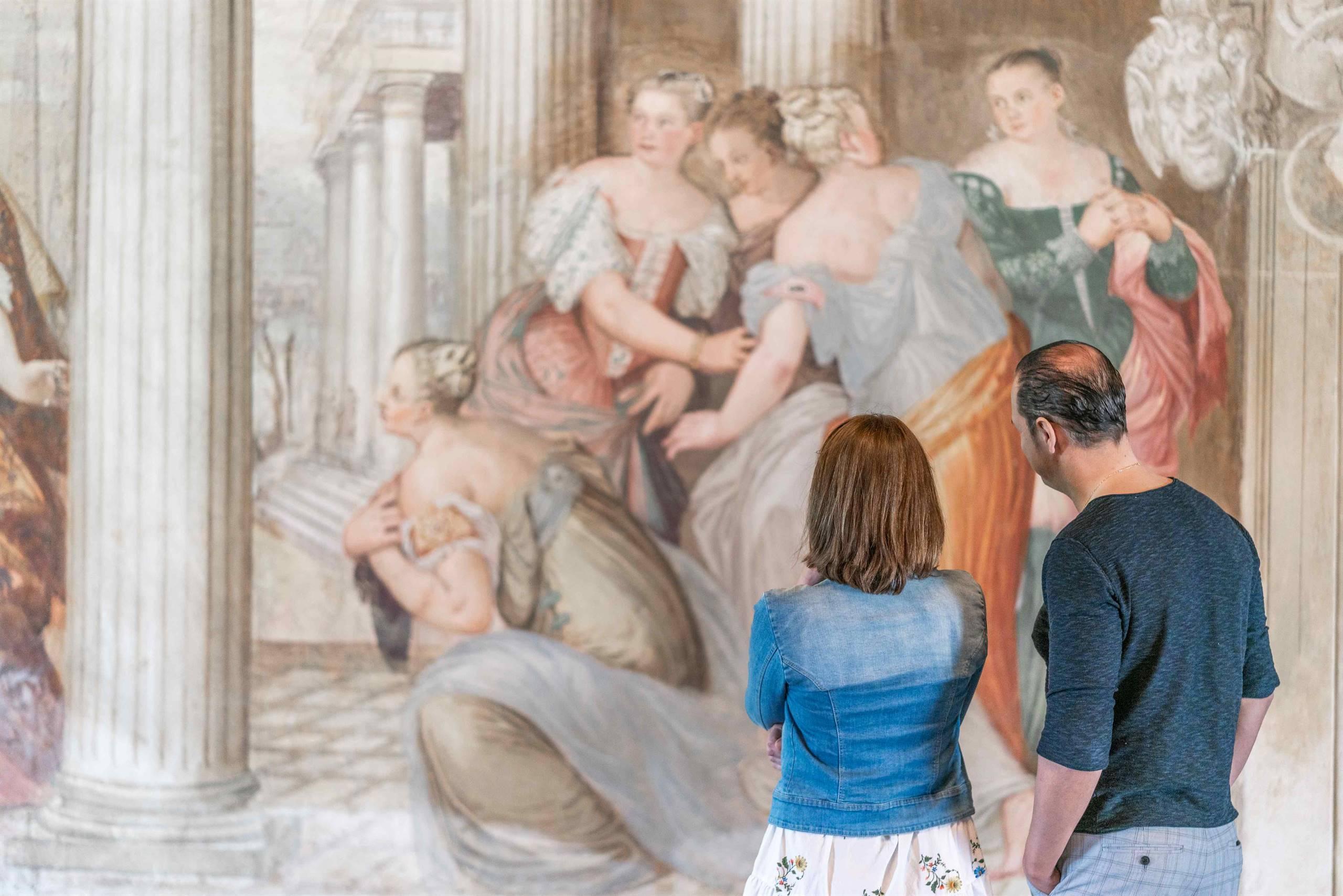
The attic statues are attributed to Lorenzo Rubini. For the internal decoration works, Paolo Veronese contributed for the frescoes, but his intervention was likely lost in the 19th century, along with Domenico Brusasorci (who is responsible for the Fall of the Giants in a ground floor room) and Ridolfi for the stuccos. In the 18th century, Giambattista Tiepolo also intervened in the decorations of the hall. Much of Tiepolo’s frescoes have been removed and are kept at the Art Museum in Seattle.