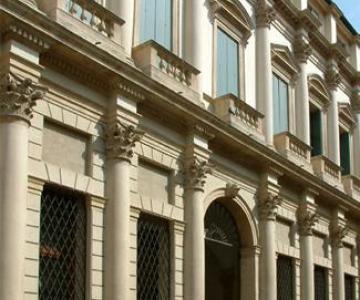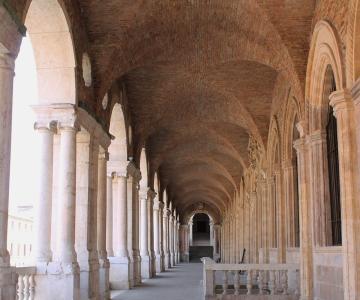
The church of Santa Maria Nova is a single-nave structure, whose walls are punctuated by full-height Corinthian semicolumns on tall bases, which follow a tight rhythm defining an architectural frame of strong plastic vigor, culminating in the coffered wooden ceiling. Between the semicolumns are arches and panels with stucco frames.
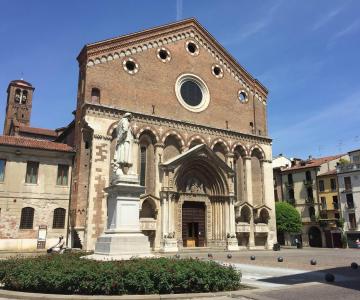
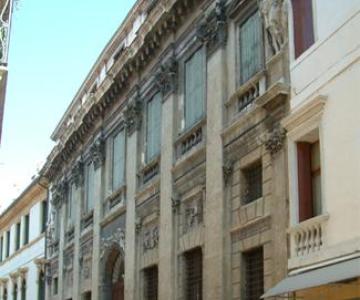
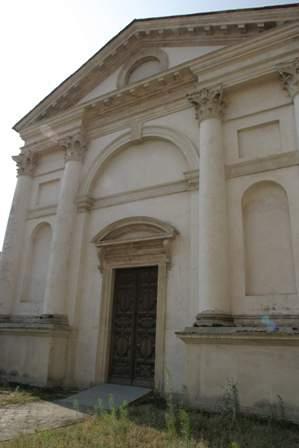
The tetrastyle façade is divided into three sections by Corinthian semicolumns on tall pedestals common to the two lateral pairs, with an interrupted entablature in the central intercolumn. It is topped by a triangular pediment with a circular oculus; in the central section opens the portal set within a high blind arch, while the narrow lateral intercolumni host rounded niches and rectangular blind panels.
The compositional scheme of the front has been attributed by scholars to that developed by Palladio for the church of San Francesco della Vigna in Venice, and based on this analogy, Palladio’s authorship of the church's design is supported, although it is difficult to attribute it to other artisans present in the Vicentine cultural context of those years. The internal space, whose shell with pronounced plasticity responds well to Palladio's compositional style of the later years (as seen in the Loggia del Capitaniato), resembles the cell of an ancient temple very similar to the design of that of Nimes published by Palladio in I Quattro Libri. Therefore, the church represents the only completed religious building, aside from the Valmarana chapel and the limited interventions in the cathedral, designed by Andrea Palladio and built in Vicenza.
The decision to build the church, annexed to the convent of the Augustinian nuns of Santa Maria Nuova founded in 1539, was ordered by Ludovico Trento in his will of 1578. It is very likely that the project was drafted by Palladio in the same year and completed, after his death in 1580, by the master builder Domenico Groppino, whose name appears in the documents.
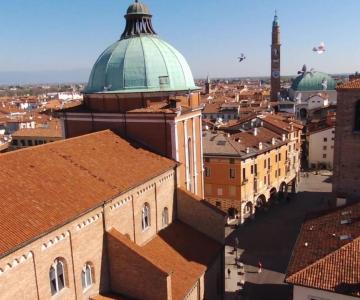
The church was already built by 1590 and completed in 1594. In the seventeenth century, it was at its peak, although already restored at the roof at that time, but then it declined in the nineteenth century after the Napoleonic confiscation and subsequent state of neglect. Owned by the Municipality of Vicenza, the building has recently undergone a preliminary recovery intervention.
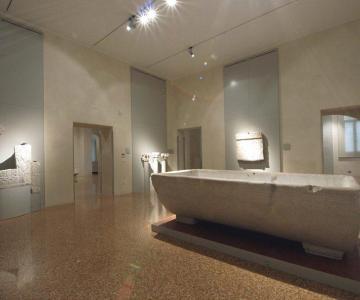
The interior of the church was enriched on the sides and in the coffered ceilings with paintings by the major artists working in Vicenza in the sixteenth and seventeenth centuries, such as the Maganza, Andrea Vicentino, Palma il Giovane, Francesco Maffei, and Giulio Carpioni, works dispersed following the deconsecration of the church in the early nineteenth century.