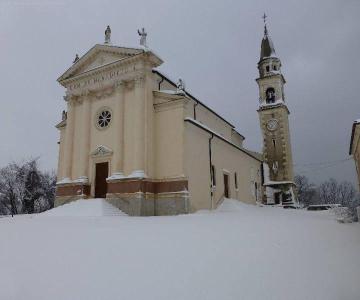
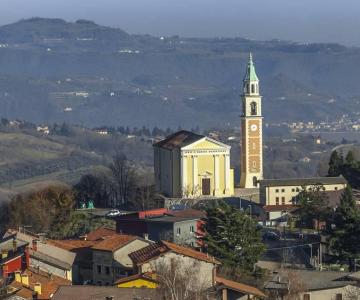
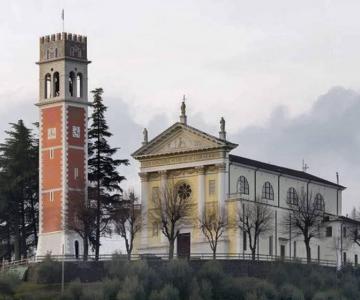
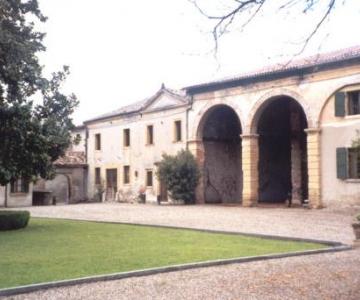
A true jewel of art is the church of Saint Michael, better known as the sanctuary of the Madonna della Strà. The first dedication of the Stra' church to San Michele Arcangelo belonged to the desire of the faithful to obtain his protection. The cult of this saint began in the 5th century in southern Italy and then spread throughout the country, facilitated by the progressive expansion of the Lombard population. A purely military saint, he particularly developed his influence along the river communication routes, as certainly happened also for Belfiore. The parish church was built in 1143, as evidenced by a Roman inscription which specifies that the architects Borgo and Malfatto qui tunc habitabant in Veronensi castro (i.e. on the left of the Adige) built the Church in 1143, Ambrose being priest and Bishop of Verona Teobaldo. Nothing is known about the designers, the architects Borgo and Malfatto, despite historical research on Veronese papers. A certain Alberico da Zevio also contributed to the work, but there is no further information about him either.
The numerous Roman tombstones in the church, however, suggest that it may have been built on the remains of previous buildings, built in a limited period of time (from 10 to 70 years in the 12th and 13th centuries). It certainly arose on pre-existing buildings, pagan first, Christian later, belonging to the Lombard period.
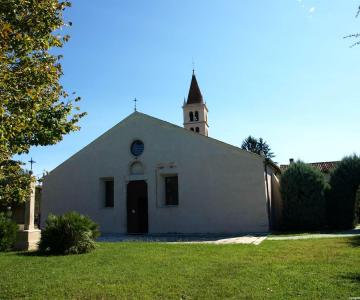
The exterior of the church
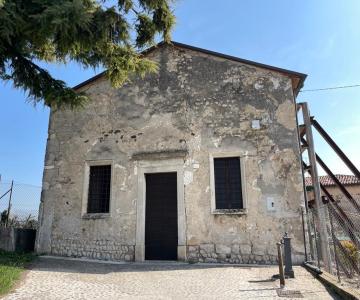
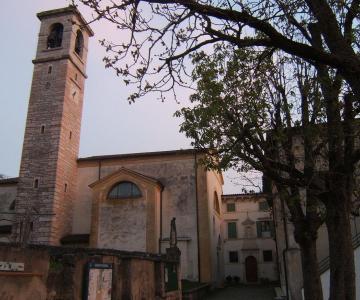
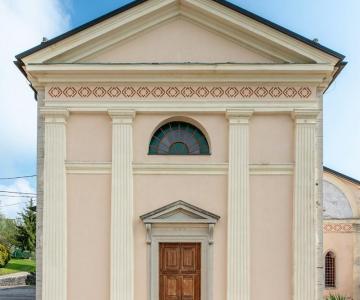
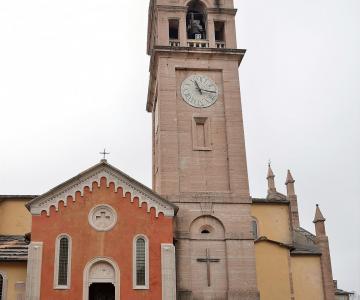
The building is made up of the following material: terracotta, tuff, moraine pebbles and marble. Of Romanesque style in its essential features, the church has simple, severe forms, with few but very fine relief decorations. The exterior is elegant and with great attention to detail, although the composure and sobriety of the surfaces and the expressive method, fundamental in Romanesque art, are highlighted. The sloping façade, surrounded by a frieze of polychrome hanging arches, is made up of courses in tuff and terracotta and features a hanging porch (narthex), supported by large stone corbels, above which there is a mullioned window surmounted by a small window divided into a cross. The façade, along the slopes of the roof, is also elegantly demarcated by a frame-contour of small saw-toothed rampant arches, and in correspondence with the main nave there is an elevation, which gives impetus to the construction. The church is surrounded by a wall with a gate. Once upon a time the fence consisted of a very high wall, built about three hundred years after the construction of the parish church, then reduced to its current state. The ancient wall was so high that it erased the existence of the church from passers-by for years.
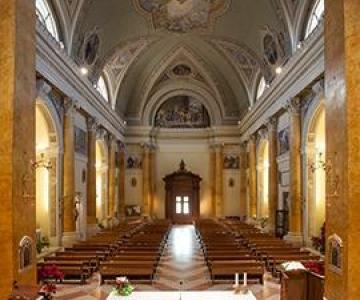
The interior of the church
The interior of the church has three naves with three apses and is covered by a trussed roof. The division into naves is obtained with rows of columns alternating with pillars: respectively three columns on each side alternating with two pillars. The walls are made of tuff "bolognini" in their lower part. Above, however, the layers of tuff alternate with bands of pebbles in a herringbone pattern. The church is not perfectly rectangular: it turns out, in fact, that the columns and pillars are not on the same line (they differ by almost half a meter). The first pair of columns on the marble shafts bears two capitals with eight smooth segments. The second column on the left bears a tuff capital, (Corinthian) of an unusual type, with three rows of thorny acanthus leaves, from the 12th century. The two columns that are in front of the presbytery are half-walled in two pillars and bear two pre-Romanesque tuff capitals, certainly spoiled material. The rings of the arches are made of tuff ashlars and the wall above them is made up of rows of tuff.
The frescoes
The frescoes in the church are part of that complex movement of mural painting that embraces the entire area and which, starting from the early Middle Ages, has described through the signs of faith the most significant pictorial testimony of the middle piedmont plain east of Verona. In the past, in the church of the Madonna della Stra' there were paintings on wood representing the twelve apostles with niches and separate pictures and a representation of St. Michael, which are unfortunately lost today. Nobody had realized the presence of frescoes, because in the restoration of 1651 they were covered by lime; in the restoration of 1905 some of the frescoes came to light. The corrosive action of time has been compounded by human neglect and, finally, destruction. It is not possible to hypothesize the space occupied by the frescoes; it certainly was relevant. Nor is the hand of the person who executed them identifiable. The dating appears easier and can be traced back to the 14th century. Those described are figures of men and women who lived and died with a reputation for sanctity. The presence of the apostle and the crowned Saint, in the second column on the right, of Saint Agatha in the second column on the left, of Saint Bartholomew, of Saint Onofrio, of Saint Mary Magdalene and, above all, of a bishop, demonstrate the progress of Christianity and make the faithful reflect on their own spiritual journey. The frescoes on the pillars were restored in 2015. The description of the work carried out was extensively detailed in a booklet, which was distributed to each family in the Parish of Belfiore.
The apses
The apses repeat the usual pattern of the Veronese typology. The northern apse was probably redone. The central apse has a rough masonry at the base, where rows of tuff are alternated with two or more courses of pebbles, while in the upper part, which ends in hanging arches identical to those of the facade, it has, in the centre, a single-lancet window decorated with double ring that encloses, within heart-shaped lobes, lanceolate palmettes and four petals, surmounted by two peacocks. The southern apse is similar to the central one with three single-lancet windows, one of which is hidden.
The statue of the Madonna with the child
The “Madonna with Child” is a polychrome wooden sculpture by the Veronese artist Giovanni da Zebellan; The painter Leonardo di Desiderio degli Atavanti also collaborated in the creation of the work. Commissioned by the Company of the Blessed Virgin, it was sculpted and placed in the church of San Michele di Belfiore in 1497. The restoration, promoted by the Superintendence of Fine Arts which took place in 1986 and 1988, made it possible to discover the author's signature and the date of execution of the work on the sides of the statue's stool; painted in black with the characters of the time we read the following writing: MADON/A DELA CON/PAGNIA/DE PORCI/LE ANO1497. The statue can now be admired in all its beauty, with the Virgin's original dress decorated in gold with refined red lacquer embroidery and the internal part of the mantle colored blue. The very human, soft and delicate face of the Madonna, gathered in prayer with her hands clasped over her little Son, expresses maternal grace and calmness. Even the Child, who holds a robin in his hand, shows his beautiful golden hair and the fine, patiently drawn folds of his skin; these details which in the past had been summarily repainted and completely hidden.
The bell tower
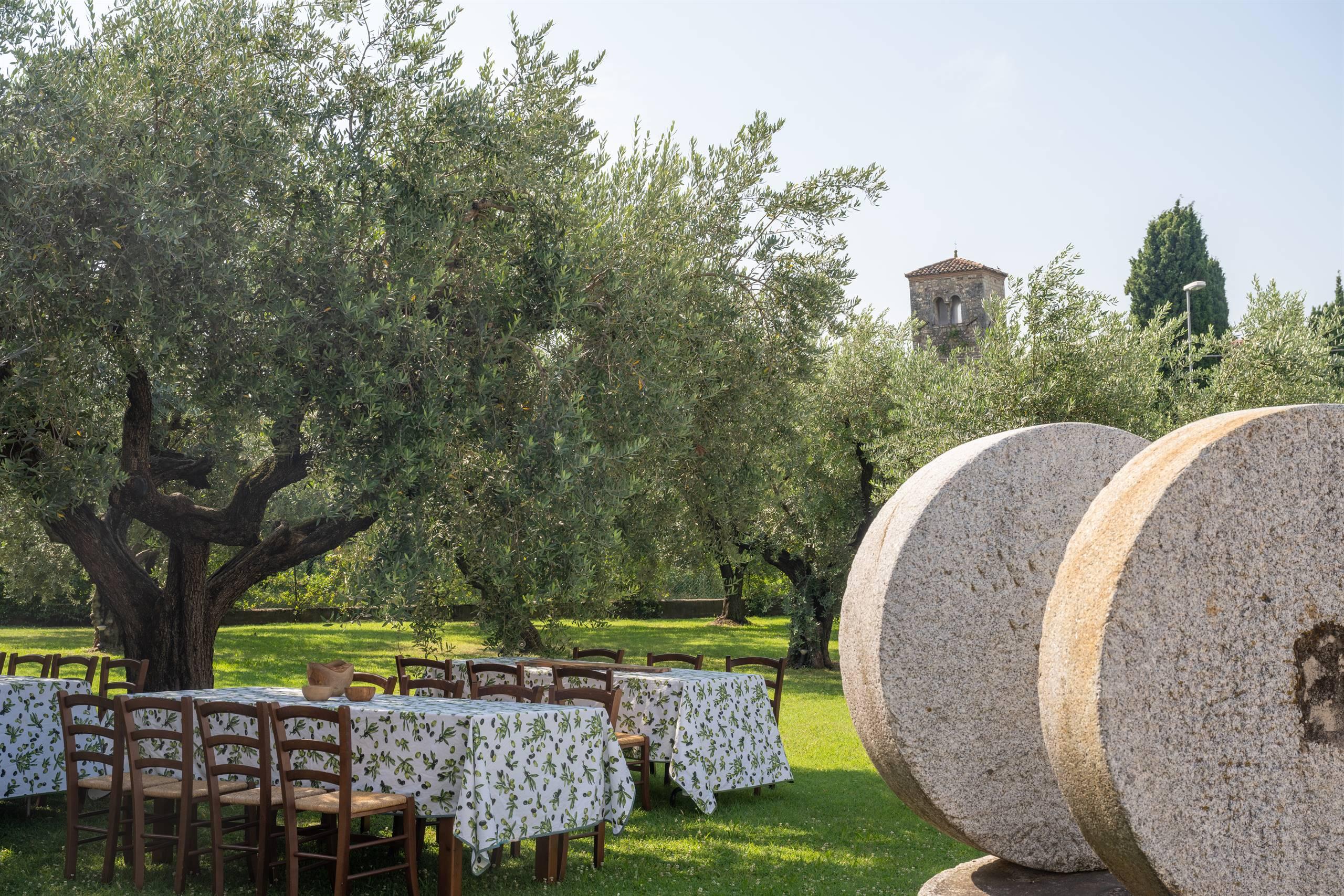
The bell tower, with a square plan, is difficult to date: it is certainly original even if it has undergone considerable alterations over time. The bell tower barrel shows courses of irregular pebbles mixed with tuff, while the northern side is entirely in tuff; just over half of the way you can see traces of mullioned windows that have been closed. The mullioned windows of the cell are Renaissance. The base of the bell tower features different materials (bricks and stones of various sizes) to testify that the construction took place in different eras.