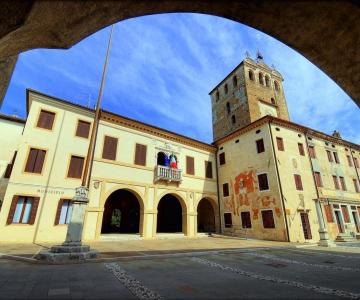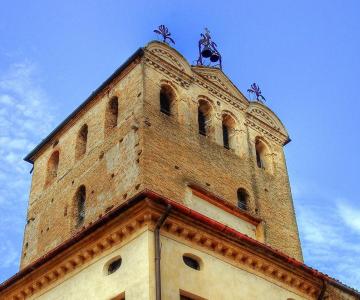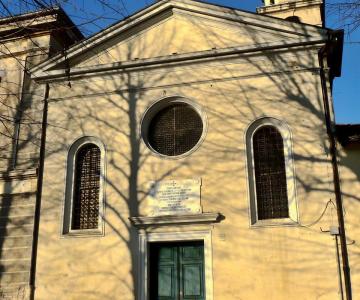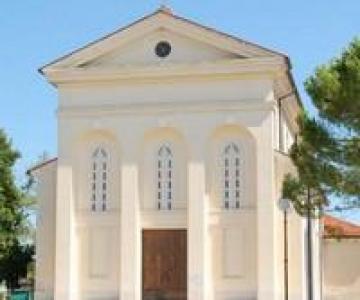
Jewish synagogue, it became a Christian church in 1559. Consecrated by the Bishop of Ceneda on October 22, 1559. It underwent various internal and external transformations. Simple and austere façade, it was restored in 1868.
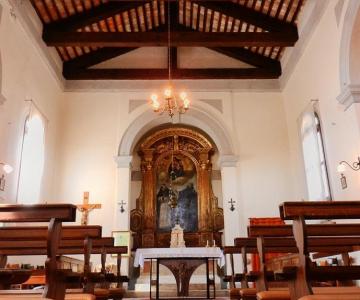
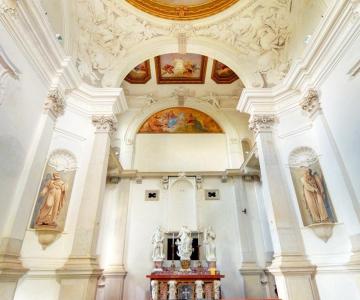
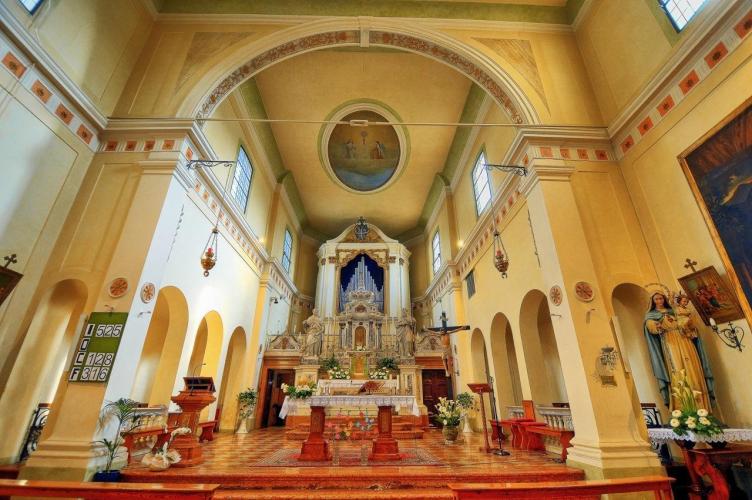
Inside the cathedral, there is a single nave, full of light, with a painted ceiling dating to the late 19th century. In the center is “The Triumph of St. Mark”, near the entrance is “St. Prosdocimus in the act of baptizing”, next to the choir is “the transfer from Settimo to Ceneda of the remains of St. Tiziano” (formerly bishop of Oderzo), on the sides “St. Anthony and St. Francis”. All the works are attributed to the Sanfiori.
The choir is from the 18th century and occupies, along with the sacristy, the area where the Jewish cemetery was located; it is separated from the nave by a majestic semicircular arch resting on two pillars. The white marble balustrades beautify the presbytery. The large altar is in Baroque style with a double tabernacle enriched with elegant columns. Two statues on the altar: on the right St. Mark, on the left St. Prosdocimus, patrons and protectors of the Christian community of Portobuffolè. A large, austere wooden crucifix reveals the influence of the German school of the 15th century. There are two side altars: to the left, upon entering, is the altar dedicated to St. Anthony in Baroque style. The table, shaped like a tomb, contains a reliquary with the relics of St. Gervasius, Milanese martyr.
On the right is the altar of the Rosary, blessed in 1726, with an unknown author’s painting, representing “the Madonna with Child, surrounded by little angels”, at the feet are St. Dominic and St. Catherine of Siena.
The side altars are attributed to Torretti, a great master of Canova, while the main altar is attributed to Ferrari. Above the organ proudly displays the coat of arms of the City, delivered to the Magnificent Community of Portobuffolè by the Most Serene Republic of Venice.
Above the Baptistery is a panel by Francesco Da Milano, a painter active in the diocese of Ceneda known for a wide production of sacred character, dated around 1536. It depicts the Virgin being assumed into heaven, with the apostles around her empty tomb; in the foreground are St. Mark and St. Prosdocimus. The background depicts a landscape of rocky mountains and a castle with a tower, dear to the artist.
Two paintings by a contemporary artist adorn the right wall: they depict the Crucifixion and the Nativity.
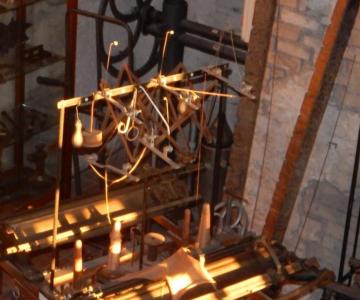
The true gem of the Cathedral is the organ by the famous master Gaetano Callido, completed in Venice in 1780 and transported here “by boat along the Livenza”.
It cost over 4030 gold Venetian lire and features 471 pipes made of a tin-lead alloy, all handmade.
A beautiful Baptistery made of monolithic stone, dating to the mid-16th century, with an octagonal wooden roof from the following century, is located just after the entrance on the left.
At the top of the nave, before the steps leading up to the presbytery, is the family tomb of the archpriest Angelo Milani (1729). Another similar tomb can be seen at the foot of the left altar, dedicated to St. Anthony, and belongs to the noble Faces family (1713).
Finally, the statue of the Pilgrim Madonna with Child, located at the head of the nave on the right, in the act of inviting the faithful to pray the Rosary, is well executed. It is the work of a Val Gardena artist, commissioned around the middle of the last century.
Portobuffolè became a parish in 1563. Previously, the Christian Community consisted of two Curacies, located outside the castle: one at Rivapiana, of San Prosdocimo, the other, older, of Santa Maria in Settimo, entrusted to a Rector since 1374. In 1563 the two Curacies were united and it obtained the title of parish, with a papal bull from Pius IV and a decree from the Doge of Venice. Don Giuseppe Fantis was elected by the Municipality in 1603, who changed the title of parish to archpriest, a title later recognized both by the Curia of Rome and that of Ceneda. The church was Jus patronato.