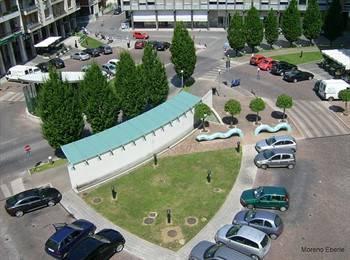
It is located at the edge of the historic center, in the area historically known as the Brolo. Built in the 1970s, it is a rectangle measuring 60 by 85 meters, surrounded by seven-story apartment buildings, with a continuous portico on the ground floor.
Before the intervention, carried out by the Public Administration since 1993 as part of a broader project for the redevelopment of central areas, the square, paved in bituminous asphalt and intended for parking, was characterized by a traffic flow running alongside the porticoes on two sides, considerably penalizing them.
The project included moving the road to the center of the square, redeveloping the porticoes. Two parking areas were built on either side of the road, flanked by a tree-lined cycle-pedestrian path with two-way traffic.
The new shapes of urban design, better visible from above, are suggested by the city’s textile production history, metaphorically redrawn by the tips of shuttlecocks, scissors, threads, and shearing hooks, which blend with the historical layers of the built fabric.
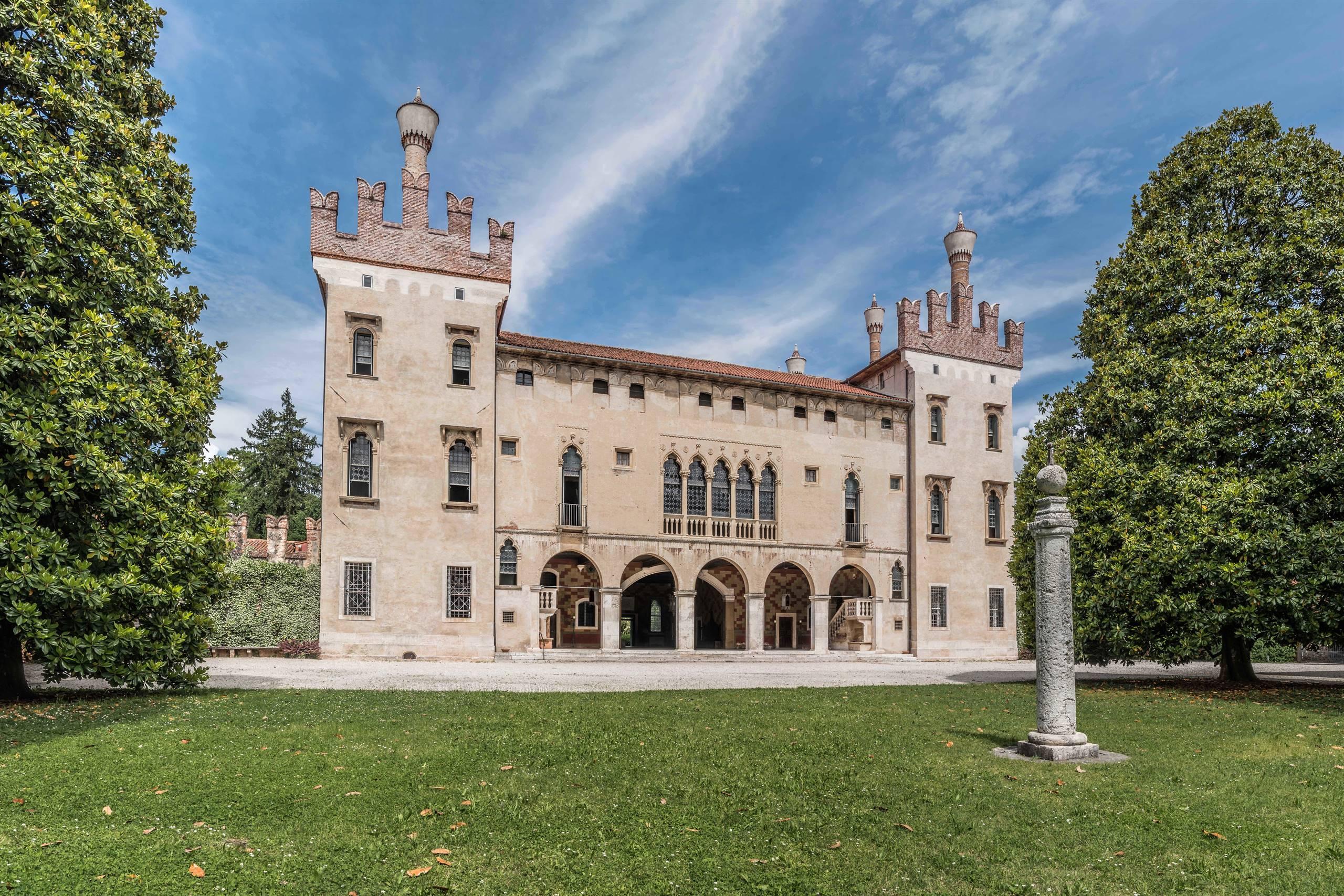
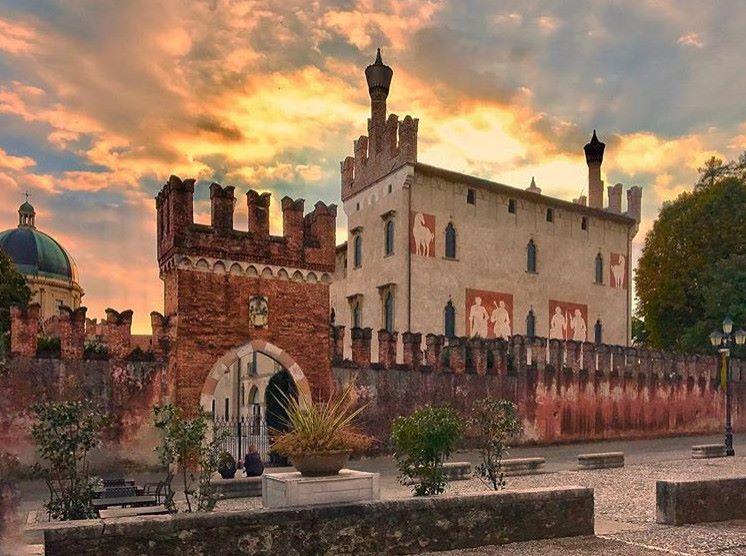
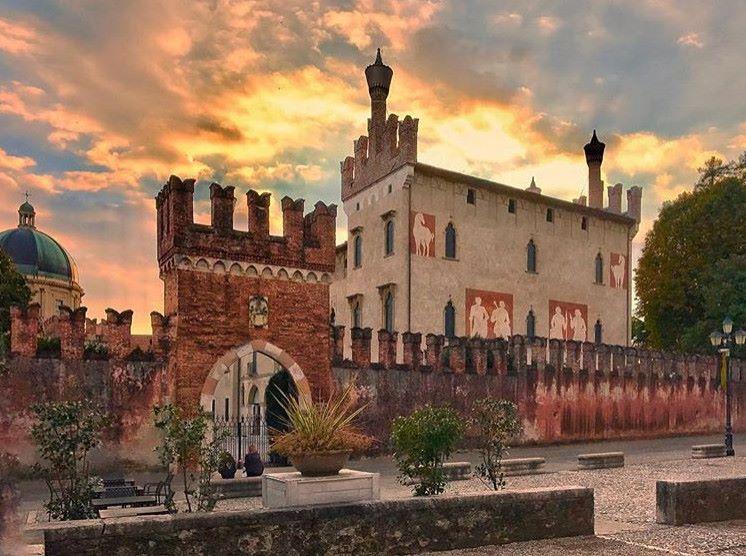
Two shuttlecock tips, oriented towards the ancient castle, mark the perimeter of the new square, while a pair of scissors cuts through, identifying the pedestrian path: the two edges lift due to the cut, creating the two inclined planes of the greenhouse roof and the grassy area. The intersection of warp and weft in the green areas, treated like fabrics, determines the position of light points; a series of small knots become seats while benches, like swings, pause in the act of improbable movement.
At the center of the square along the path, some constructed elements emerge: the water fountain with the concrete wall and the glass roof, the greenhouse, the red steel pipe, the green flowerbed. Light plays a fundamental role in the design, acting as a signal for areas and pathways: the porticoed perimeter diffuses an intense and constant light, reflected in the central pedestrian pathway; in the parking areas, a low-intensity light indicates the individual parking spots on the ground, while an intermediate light illuminates the green areas. The colors and the texture of the pavement identify the different functional areas, while the choice of paving material is dictated by economic reasons and the need for intervention and maintenance of the complex existing utility network.
The bao is a wavy metal structure that enters and exits the ground, like a red thread out of scale with a needle at the top attempting to stitch the urban land. This work has become so popular that this square is also known as “bao square.”
The water basin, on the other hand, was created in memory of the historic irrigation channel, the engine of the textile economy in Schio. The latter is made of concrete and illuminated by an optical fiber system submerged in the water.
Photo: archive of the Municipality of Schio.