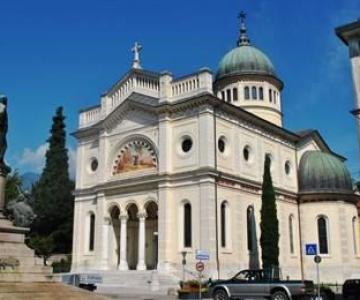
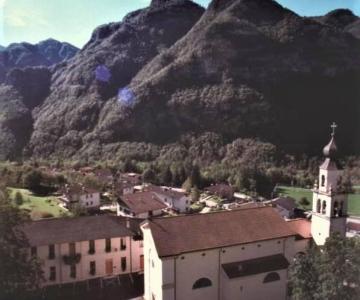
The small church dedicated to Mary Crowned was built on the initiative of the dismissed Scledense Girolama Rossi, who considered the populous district of Sarèo (current Via Pasubio) lacking in adequate spiritual assistance. After obtaining the consent of the Venetian Senate and the Municipality and the bishop's authorization, work began, and by 1716 the church was already open to the public. The inscription mounted on the facade of the building reads: D(EO) U(NI) T(RINO) / CUIUS AFFLATA SPIRITU / SUB AUSPICIIS / CORONATAE VIRGINIS MATRIS / HOC PIETATIS MONUMENTUM / CONSTRUXIT, DOTAVIT / HYERONIMA ROSSI DIMISSA / FUNDO PUBLICO / CONCORDI PIETATE / OBLATO / ANNO SALUTIS MDCCXVI (translation: A One God in Three. Inspired by His Spirit, under the protection of the Virgin Mother Crowned, this pious building was constructed and endowed by Girolama Rossi the dismissed, on land offered by the Community for a concordant religious sentiment. In the year of salvation 1716).
In Girolama Rossi's will, it was established that the church be endowed with two priests to ensure its custody and liturgical service. It was inherited by the Rossi family and subsequently passed to the Folco family and then to private citizens. The church always maintained the role of a place of worship open to the public.
The church was elevated to rectorate in 1912.
The chapel underwent renovations in several stages: in 1919 the decorations were renewed, in 1936 the facade and the altar were remodeled. In 1950 the interior decoration of the building was once again revised, by Vittorio Pupin, an operation that also involved the partial removal of the two side altars made in 1922. The most recent interventions have involved the general maintenance of the building and the creation of the altar facing the faithful by reusing parts of the altars partially demolished in the 1950s.
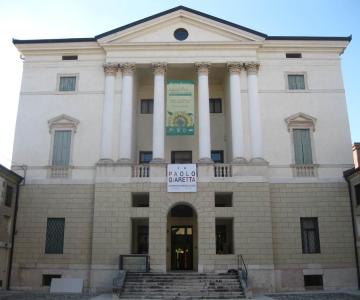
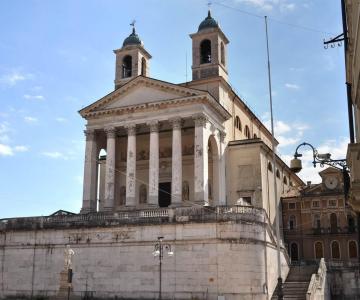
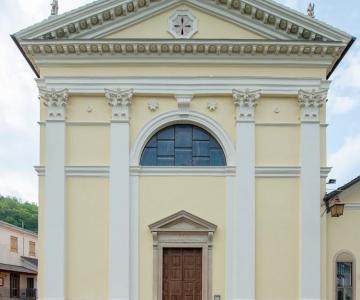
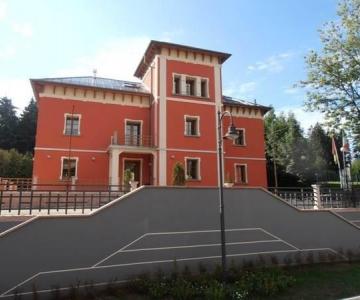
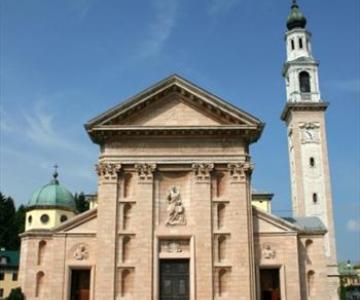
On the outside, only the facade is visible as the church is embedded in a continuous sequence of houses. The building is preceded by a short staircase and presents a balanced classical-style facade with some typical Baroque elements. Flanked on the sides by pilasters culminating in a composed capital, the facade features two large windows with stone frames, horizontally divided into two unequal halves, equipped in the lower part with grilles.
The portal, at the center of the facade, has stone moldings and is enriched by an additional horizontal element supported by volute brackets.
Above the entrance are: an elegant convex plaque indicating the origins of the church, the coat of arms of the founder's family, and a trilobed rose window. At the peak of the facade is a triangular pediment crowned by statues depicting the Madonna and Child (in the center), Saint Francis of Assisi (on the left), and Saint Anthony of Padua (on the right), the work of Orazio Marinali. At the back is the bell tower with bells from 1717.
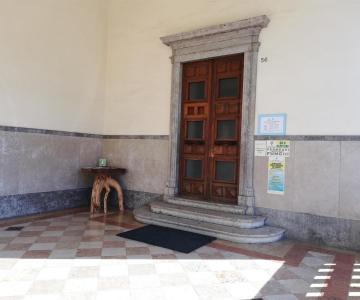
The interior of the church is a single nave and shows a sober wall decoration, and the flooring is in marble with a checkerboard pattern.
In the presbytery area is the main altar made in 1936 by reusing parts of the previous altar.
Above the altar is a tabernacle from which rises a crucifix placed between the sculptures of two Adoring Angels.
Above, on the main altar, resting against the wall of the choir, is a canvas depicting the crowned Virgin, a work by Francesco Zorzi from 1987/1988. On the counter-facade Saint Gaetano Thiene with the Virgin and the Child, an 18th-century painting by Antonio Costa.
On the ceiling is a large canvas from 1909, the work of Giuseppe Mincato, based on an unfinished sketch from 1899 by Alberto Boschetti. On either side of the trioval arch rest two canvases by Vittorio Pupin from 1953: "Madonna of the Missing in Russia," on the left, and "Saint Expeditus, Soldier and Martyr," on the right.
Along the walls in the niches, the altars made in 1922 by architect Vincenzo Bonato and resized in the 1950s. The altar of the Child Mary on the left and that dedicated to Saint Therese of the Child Jesus on the opposite side.
Beyond the presbytery extends the small sacristy, which housed some works: Saint Lucia and Saint Gaetano Thiene, wooden sculptures, the paintings of Saint John the Baptist in prison comforted by the Apostles from the 17th century, and Christ burdened by the cross by local artist Ada Zanolo.