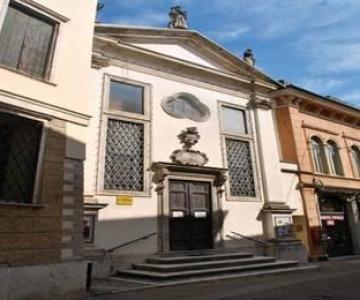
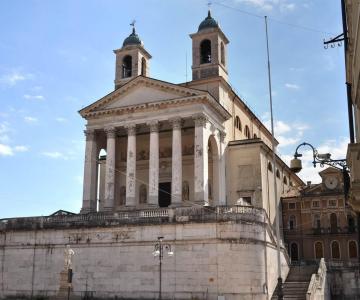
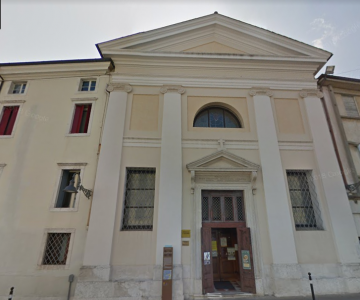
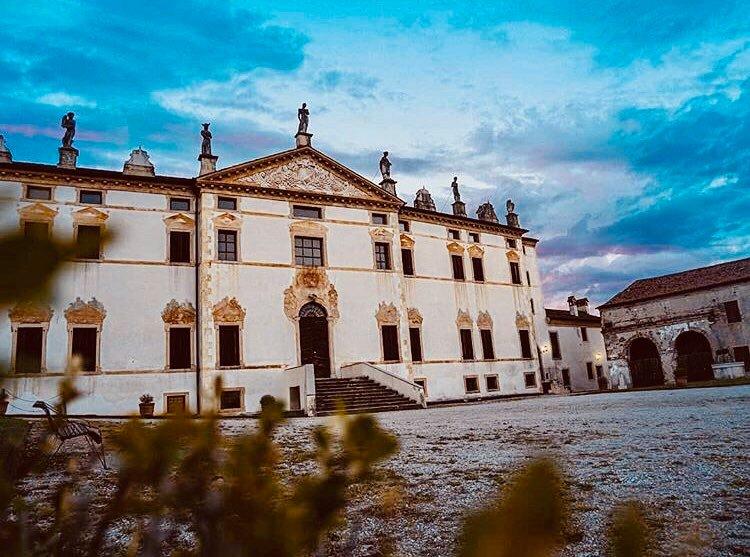
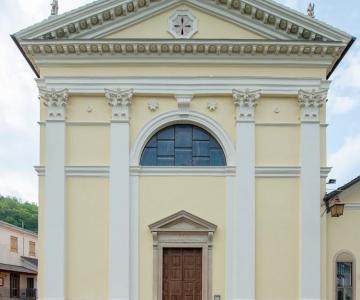
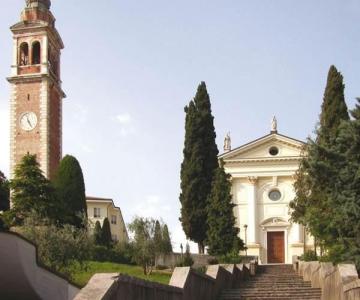
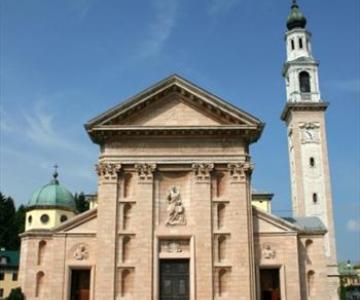
In 1742 it was externally renovated, giving it a facade in "pure Corinthian style" and adorning it with five statues.
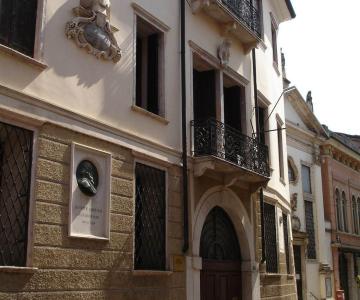
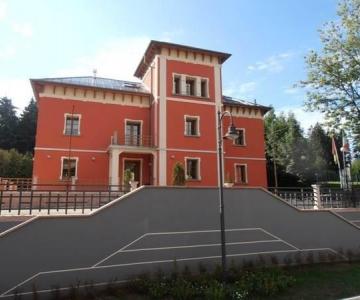
Due to the regulations imposed by Napoleon regarding the secularization of ecclesiastical property, in 1806 the Augustinian nuns had to host sisters from a suppressed convent in Marostica, and four years later it was ordered to close the Scledense convent as well. Part of the land and furnishings belonging to the nuns were sold, the church and premises fell into a period of abandonment, and part of these were purchased by the Maraschin family, who converted them into a residential palace.
A few years later, the nuns managed to buy back part of the premises of the old convent and restore it.
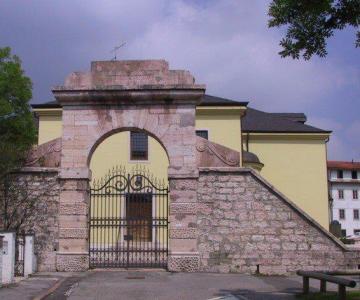
Due to the private residence of the Maraschin family, the chapel of Saint Anthony the Abbot was separated from the convent, and thus at the initiative of Monsignor Luigi Piccoli, it was decided to construct a new church dedicated to the saint, adjacent to the convent. The latter was built between 1834 and 1839 based on a design by Antonio Piovene. The new building, adorned with three statues (now preserved in the courtyard of the former monastery), was furnished with elements salvaged from the old church and from others that were closed during the Napoleonic era.
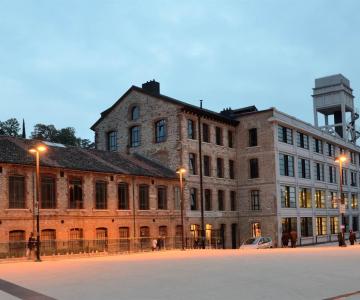
In 1879, Alessandro Rossi purchased a plot of land between Pasini and Maraschin streets, demolished the old church, and had a new one built of considerable size. In this way, he managed to avert the expropriation of the monastery made possible following the annexation of Veneto to Italy and was able to provide an adequate place of worship for the new working-class neighborhood. The new church was designed by Antonio Caregaro Negrin in Romanesque/Byzantine style and is part of the industrial archaeology heritage present in Schio.
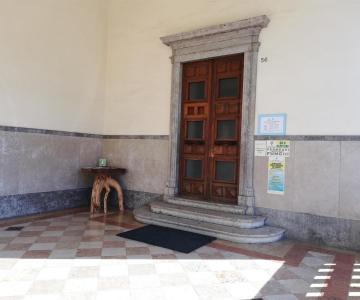
A plaque mounted under the church's portico reads: AEDEM S(ANCTO) ANTONIO / MAGNO COENOBIARCHAE AEGYPTIORUM / ALEXANDER ROSSI / FINIBUS URBIS PROLATIS / UT MAIORI INCOLARUM FREQUENTIAE / CONSULERET / IMPENSA SUA A FUNDAMENTIS EXCITAVIT / A(NNO) MDCCCLXXIX / ANTONIO CAREGARO NEGRIN ARCHITECTO (translation: Having expanded the boundaries of the city, to benefit the increased number of inhabitants, Alessandro Rossi, at his own expense, had the temple dedicated to Saint Anthony the Great, the coenobiarc of Egypt, erected from the foundations. In the year 1879. Architect Antonio Caregaro Negrin).
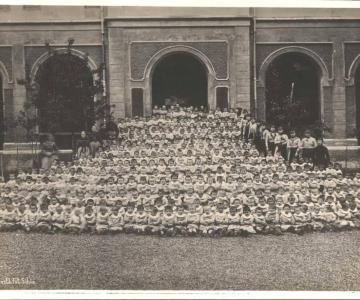
During World War I, the nuns had to leave the convent, and the church was used as a shelter for the wounded and as a food storage point. After the war ended, the nuns returned to occupy the structure.
Recently, significant restoration and renovation work has been undertaken, and the monastery was definitively closed due to the lack of generational turnover.
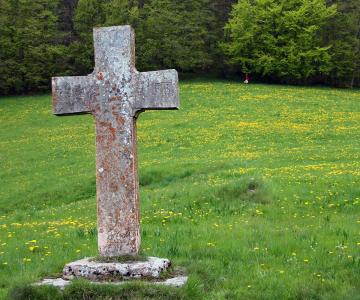
On the outside, the church has an imposing structure thanks to the central dome that rises 37 meters high. The facade, preceded by a short staircase, is divided vertically into three parts by pilasters decorated with bands, while horizontally it is divided into two halves by a thick string course. The two lateral sections are pierced by circular openings above and by tall arched windows at the ground level. The central section of the facade features a recessed portico supported by robust composite columns (enriched by lunettes decorated with images of Christ and the evangelists by Valentino Pupin), framing the entrance characterized by a central portal and two smaller ones positioned laterally. Above the portico, there is a large mosaic from 1929, Il seppelimento dell’ eremita San Paolo, by Alessandro Radi. At the top, concluding the facade, is a barely hinted pediment surmounted by a balustrade from which a stone cross rises centrally.
On the sides (only the right one is easily visible), rhythmically arranged with windows alternating with pilasters similar to those on the facade, the apse of the lateral chapels stand out. Between the transept and the presbytery area, there is a lateral entrance topped by a characteristic pediment and preceded by a few steps. In the rear area, which is difficult to see, there is a small bell tower with two bells and the semicircular apse.
The internal structure is organized into three naves, forming a Latin cross with the arms ending in apses. The central nave is twice as wide as the lateral ones. At the center rises the large dome, characterized by a series of triforiums present on the drum. The numerous windows are decorated with polychrome geometric motifs, while those along the naves, depicting various saints, are the work of Giorgio Scalco from 1966. The church has three altars: the main altar and the one on the right side are late-nineteenth-century works, while the left one, previously the main altar of the former church, is a valuable Baroque work by Orazio Marinali - executed based on a design by Giovanni Antonio De Pieri - which preserves La Madonna della cintura by Antonio Zanchi (1700). Additionally, noteworthy are the paintings dedicated to San Valentino (by an unknown author and dating from the 17th-18th century, already an altar piece in the first church of Saint Anthony the Abbot), to San Nicola da Tolentino (by Giuseppe Mincato), and the sculpture of La nostra Signora (Valentino Zajec). The entire internal decorative apparatus is remarkable and sophisticated, executed by numerous local and external craftsmen (among them: Tommaso Pasquotti, Francesco Cavallin, Pietro Dalla Vecchia jr., Vincenzo Bonato, Domenico Cavedon, Lorenzo Giacomelli, Augusto Benvenuti, Giuseppe Mincato).
The church houses two organs: a mechanical transmission Zordan from 1903 in the choir and a positive Sessa organ from 1868 positioned to the left of the main altar.