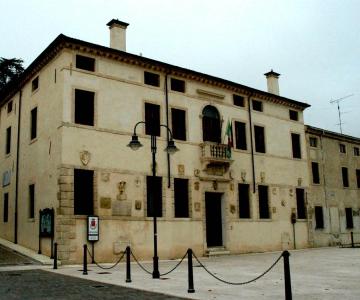
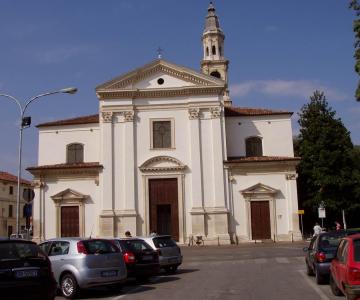
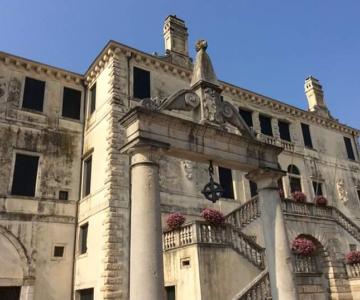
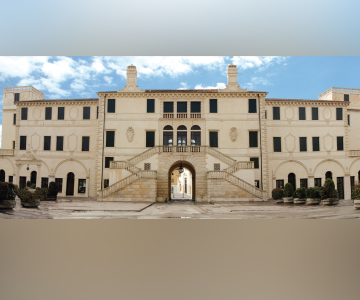
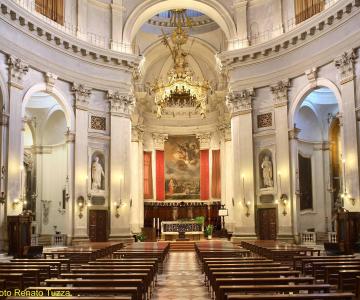
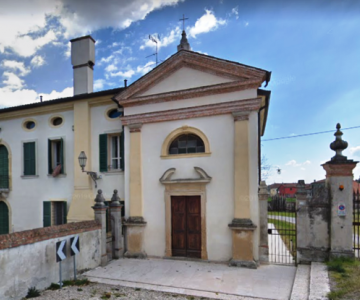
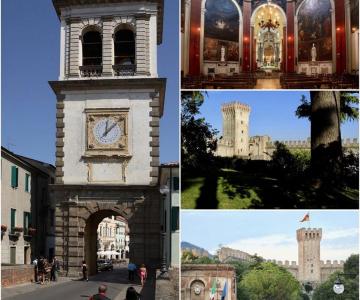
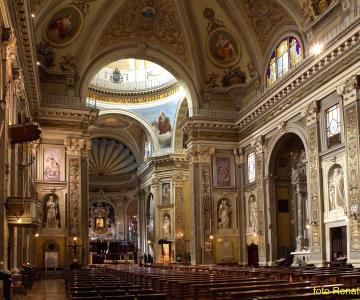
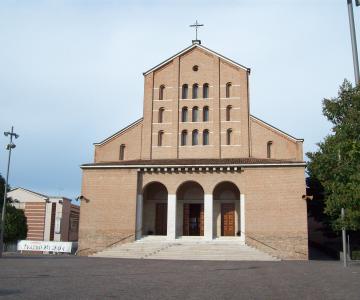
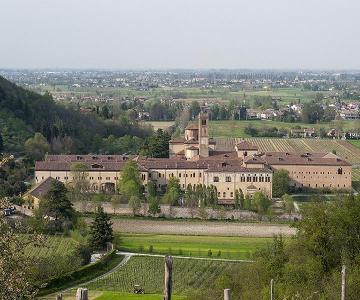
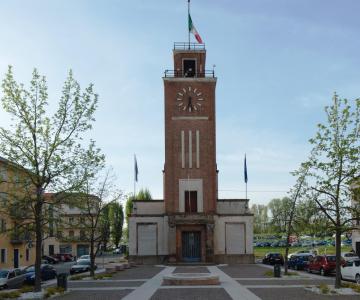
The ancient origin of the village suggests the hypothesis of an equally ancient origin of the parish church dedicated to Santa Maria. However, it is only from 1263 that the existence of a collegiate church is confirmed. Slightly elevated compared to the town center, on a delightful hill, it was rebuilt in 1740 and enlarged in 1859. Access is gained by climbing an impressive staircase of 81 steps, built in 1860. Inside, it houses a famous canvas from the 1500s by Bartolomeo Montagna, depicting the Virgin, Saint Joseph, and the Child. Noteworthy are the main altar, made of Carrara marble, with statues of Saints Peter and Paul, and the five baroque altars, one of which is dedicated to Saint Gaetano Thiene, the patron saint of Orgiano. The bell tower is a majestic tower dating back to the 1500s.
Of significant artistic value is also a wooden crucifix from the 1400s, placed on the central wall of the presbytery.
The Holy Family represents a masterpiece of undeniable value. It is housed in the Archpriest Church of Orgiano. It is a painting by Bartolomeo Montagna, which depicts the Child Jesus adored by the Most Holy Mary and Saint Joseph.
Montagna is, without a doubt, the greatest of the Vicentine painters. Indeed, Franco Barbieri writes in the volume "Questa è Vicenza" (1954): "- neither historical reasons nor those more strictly stylistic can take away from Montagna the pride of his position as genius loci acquired from secular tradition." For this reason, the Pinacoteca of the city of Vicenza has dedicated one of its largest halls to him.
Bartolomeo was born in Vicenza around 1450; most likely in Biron. His surname is Cincani, but he later acquired the nickname Montagna.
In the 1500s, he is at the height of his artistic activity. That year, writes Borenius, an eminent English scholar: Our painter completes two very important works, in which the search for rich color effects is evident: the Pietà of the Madonna of Monte Berico (which we still admire today to the right of the main altar) and the Virgin with Saint Joseph adoring Christ in the Archpriest Church of Orgiano. Therefore, our altarpiece is contemporary to that of Monte Berico, before which countless crowds have prostrated and continue to prostrate in prayer and admiration.
Of our work in particular, Borenius himself says: "The simple, imposing composition of the altarpiece of Orgiano shows the Virgin and Saint Joseph kneeling symmetrically on either side of the Child Jesus. He is on a raised platform, in a blessing pose; his upright position is in stark contrast to the delicate curved lines of his adorers, which necessarily makes him appear as the main figure of the painting. The excellence of the design of this composition deserves special consideration." The painting has always been (except during the dangerous times of war when it was removed) on the third altar to the right of the entrance through the main door.
The Virgin wears a crimson tunic, a blue mantle with a green lining, and a violet-colored zendalo (fine silk cloth). Saint Joseph has a green tunic and a vermilion mantle. Behind them, to the left, is a ruined building, further back, to the right, a town on a hill; and finally, in the distance, the blue chain of the Alps.