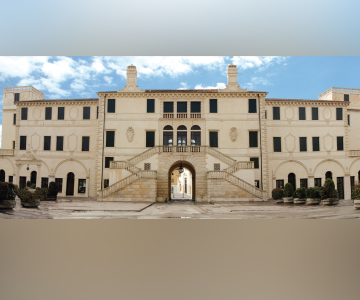
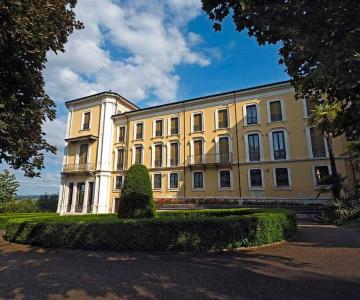
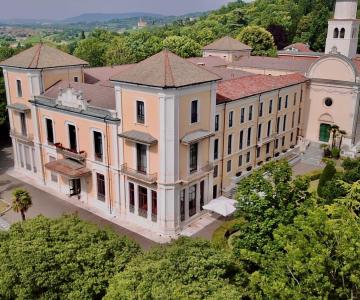
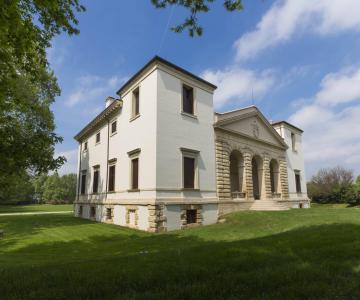
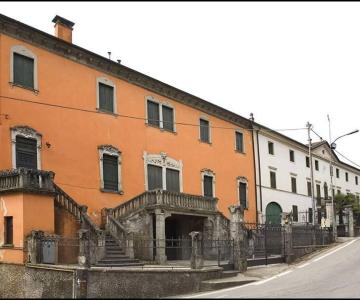
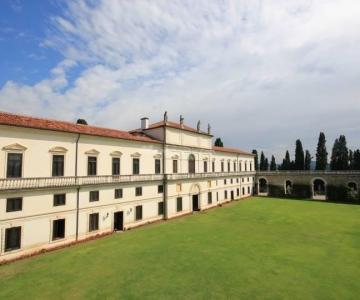
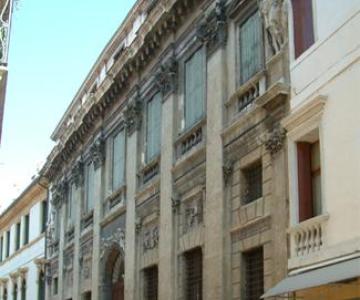
Commissioned by the Pisani brothers, the building was erected in 1556 on pre-existing structures.
By an unknown architect, tradition attributes it to Michele Sanmicheli, while Dalla Pozza credits Andrea Palladio, who was engaged at that time in the construction of Villa Pisani in Bagnolo, although stylistic evaluations do not support any of the aforementioned hypotheses.
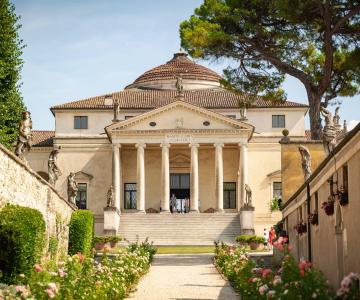
The building consists of two parts: a central section and two lateral wings built in the 18th century. The residential block is developed over four floors, two of which are noble, a rare aspect for the architecture of the time, and is enclosed by rustic stonework that highlights its corners.
The monumental balustraded staircase with triple ramps allows immediate access to the noble floor on the north side of the palace. Continuing up the stairs with one’s gaze, it is possible to notice how each floor is marked by a double base band at the windows, as well as two coats of arms between the frames of the openings on the noble floor.

Palazzo Pisani
Piazza Garibaldi, 1 , Lonigo ( VI ) - 36045
- Contacts
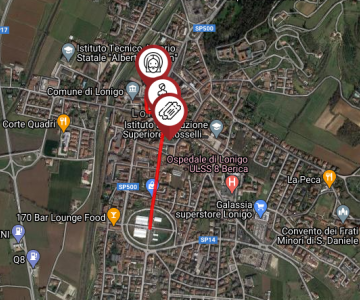
TAKE ME HERE: Piazza Garibaldi, 1