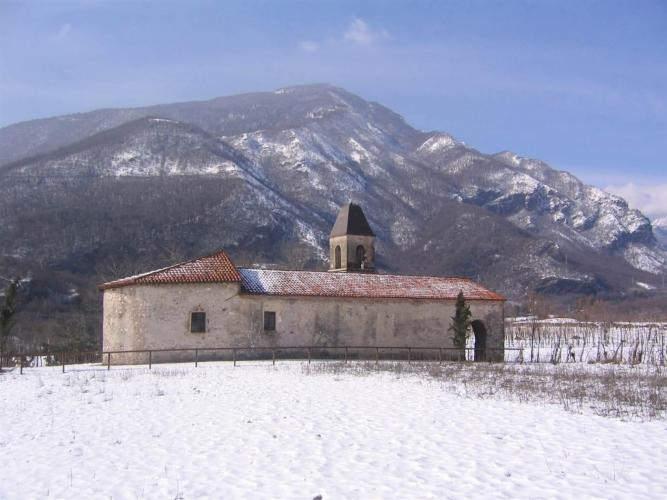
The history of the small church of Sant'Agata di Cogollo is very ancient: it dates back to the Longobard era when the Germanic people descended into Italy in 568 and took possession of the lands in Vicenza.
The church is built in the open countryside at the edge of the deep and characteristic depression where the Astico stream flows.
It is oriented to the east like all primitive churches, rectangular in shape with an adjacent probable burial area.
It is a crude construction, without artistic motifs; a poor church for poor Christians; but also one of the oldest in the area.
For Cogollo, it constitutes the cradle of its Christian faith, indeed it has always been considered the first community church. (Simeone Zordan)
A second document from 1186, the historian of the Abbey of Nonantola (Tiraboschi) speaks of five possessions that the Abbey owned in this area.
Now, having established that in the second half of the 8th century, the work of catechesis by Benedictine monks began in Alto Vicentino, there is a tendency to credit the church of S. Agata built in the 8th century.
Nowadays, unlike the other four churches, Sant'Agata no longer has the burial area and is also the only church isolated from a time when the municipal road leading to Caltrano passed nearby and was also in communication with San Giorgio. The building has been restored and inside, behind the altar, one can admire a painting depicting the saints Agatha and Catherine. It remains a place of peace amidst the meadows, surrounded by the greenery of the woods.
Curiosity: With the defeat of Emperor Frederick Barbarossa at Legnano by the Lombard and Veronese League (1183), local realities evolved and gained their own identity: the “cascine”, the “Villages” of Caltrano, Chiuppano, Cogollo Velo, and Arsiero became free municipalities, each with its own territory.
It was therefore necessary to divide the territory among these municipalities, which until then had seen a single administration.
The meeting in the church of S. Agata in Cogollo on July 31, 1202, represents the recognition of these identities; indeed, with the definition of the boundaries on the right of the Astico and the approval of some agreements regarding grazing and wood rights, the birth of the municipalities of Arsiero, Velo, and Cogollo is officially sanctioned and, subsequently, from the territory of Arsiero, the municipalities of Posina and Tonezza.