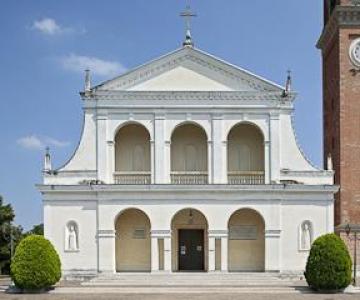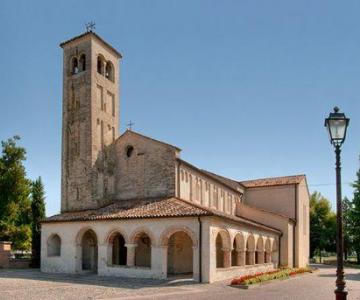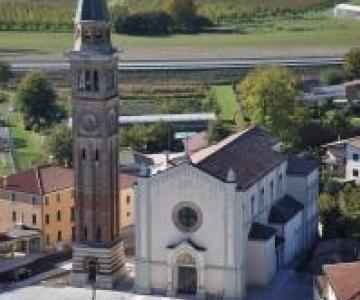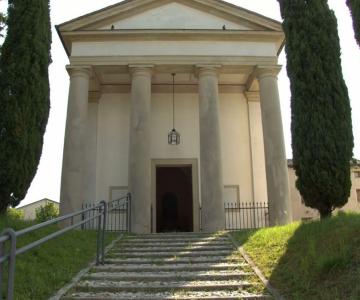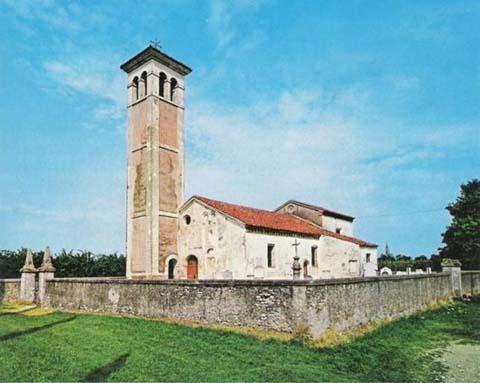

From some historical news, it is known that in 737 the parish of San Polo was entrusted to Aquileia, and it is precisely in that year that San Giorgio is mentioned for the first time. It is therefore very likely that the church was built between the 7th and 8th centuries A.D. Other ancient news about the parish is found in a document from 1034 that lists the parishes between the Piave and Livenza rivers. In 1147, Eccelino the Balbo set off for a crusade; upon his victorious return against the Saracens, he was granted in feud the Villa of San Polo and the advocacy (a noble office responsible for administration, defense, taxes, tolls, vassals, and dependents) of San Polo and San Giorgio. But in 1292, Patriarch Raimondo requested the return of the properties entrusted to the Eccelini, and thus began a flurry of excommunications and subsequently battles and wars between the two contenders. The history of the little church continued over the centuries until the expansion of the 18th century, when the apse was added, leading to the loss of two episodes of the story of San Giorgio.
Inside, a stunning cycle of frescoes, recently attributed to Giovanni di Francia (circa 1420–1480), is preserved. This painter worked in Feltrino during the first part of his life, leaving numerous testimonies, including a Last Supper, previously using the same models as San Giorgio in Servo di Sovramonte. The original cycle includes, in a clockwise direction from the left as one enters, “The Madonna of the Rosary with Saint Francis,” the Last Supper, the Story of Saint George in four “Capituli,” two of which were lost during the 17th-century expansion to create the apse, Saints Sebastian and Bernardino of Siena, and Saints James the Greater and Anthony the Abbot. There are other frescoes from subsequent eras in the church, including two Madonnas with Child, one dated 1520 and the other from the late 15th century, a Saint Roch from the 16th century, and a Saint Martin from the 18th century. There was also a fresco on the outside of the main facade depicting another Madonna with Child, which unfortunately no longer exists. The Last Supper is undoubtedly the most famous fresco, characterized by the presence on the table of red wine and shrimp, typical products of San Polo even at the time of the fresco.
The first fresco of the Story of Saint George represents the knight meeting the princess, daughter of the king of the city of Selene, who sacrifices herself by the lake's shore to placate the dragon threatening the population. Beneath the fresco, there is an inscription in the vernacular of the time recounting the episode. In the last painting, Saint George, after taming the dragon and freeing the city of Selene, baptizes the inhabitants represented by the king, queen, and princess.
Recommended pamphlet "Cimadolmo, Ormelle, San Polo di Piave," Le Tre Venezie, Copy available for consultation at the Iat of Oderzo.