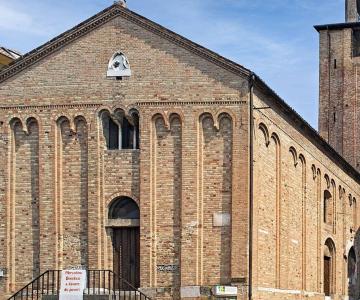
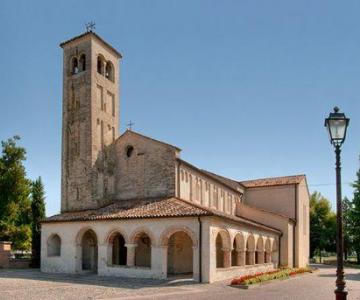
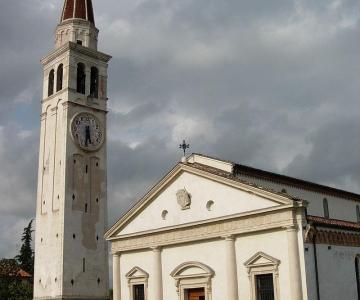
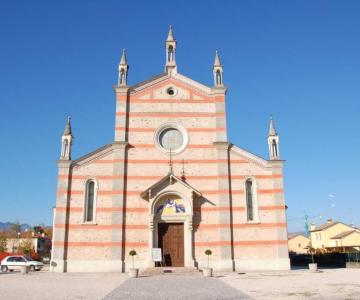
The construction of the Church of San Nicolò began in 1303 when Fra’ Nicolò Boccassino, who became Pope Benedict XI, traditionally donated 70,000 gold florins. Occupied by the French and repurposed as a warehouse at the end of the 18th century, it was completed around 1858. The style is transitional between Romanesque and Gothic, with a Latin cross plan, three naves, and apse chapels.
The twelve columns were decorated with frescoes in the 14th century by local and non-local painters. The most famous is the one frescoed by Tomaso da Modena around 1352, depicting four saints: Saint Romuald seated at a desk, with the kneeling donors; Saint Agnes and Saint John the Baptist; Saint Jerome in the study.
In the right nave, the attention is drawn to the Saint Christopher frescoed by Antonio da Treviso around 1410. Next to it is the door to the Sacristy, which features a beautiful Annunciation with Christ and Saint Nicholas, dating back to the mid-14th century. The organ, still functional, was built by Gaetano Callido (1778-79), and the painted doors were created by Jacopo Lauro (circa 1600) showcasing Stories of Blessed Benedict XI.
In the apse of the main chapel is the altarpiece of the Madonna on a throne with a musical angel and saints, started by Fra’ Marco Pensaben, the “Maraveia,” and completed by Gerolamo Savoldo in 1521. On the wall, one can admire the Renaissance tomb monument of Agostino Onigo. The main altar features the Last Supper (Antonio Burini, 1666), achieved through inlay work of mother-of-pearl and marbles.