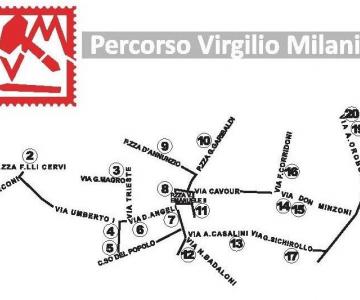
The Gender Itinerary in Rovigo is a cycle-pedestrian route of about 11 km, with educational and/or tourist characteristics, through public places that the Municipality of Rovigo has dedicated to female figures distinguished in various fields of history, culture, and politics.
It has two starting points: one further away, to include via Lina Merlin, from Cen.Ser. (Service Center) and one from CUR (University Consortium of Rovigo), between the two railway and bus stations, which are the gates of the city as they are places of arrivals and departures.
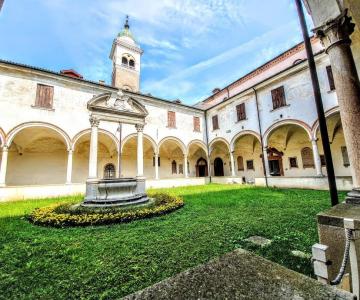
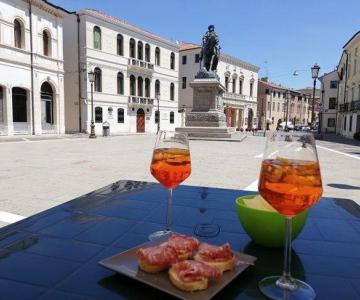
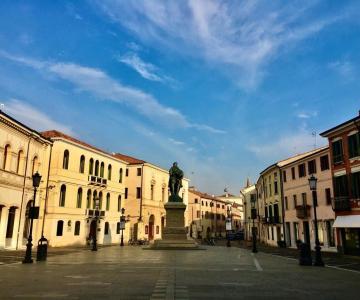
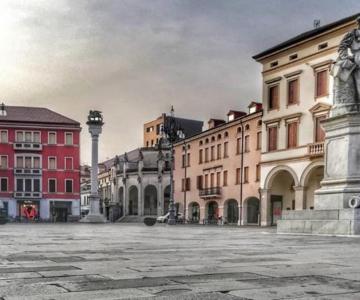
In an ideal cordon around the historic center of the capital, with some excursions into adjacent neighborhoods, it connects the “pink streets” – while also offering a panoramic view of urban spaces, in addition to historical and knowledge recovery – to arrive in Piazza Vittorio Emanuele, the urban living room facing cultural sites (Accademia dei Concordi and Palazzo Roverella), which house many works by “our” women: almost an invitation to discover them.
It is also configured as a flexible proposal that can be freely interpreted according to interests and availability of time, to be undertaken in its entirety or in sectors (e.g., only the center or the neighborhoods) or as “thematic journeys” (e.g., the streets of literary women, religious women, etc.).
It starts from Lina Merlin (1887-1979), the first female senator and one of the 21 Founding Mothers, or from Chiara Lubich (1920-2008), founder of the Focolare Movement. Then from Margherita di Savoia (1851-1926), the first queen of Italy, to Ada Negri (1870-1945), the “poetess of the Fourth State,” and Maria Montessori (1870-1952), the first female doctor in Italy and founder of the method that bears her name. Issicratea Monti (1561?-’81) was a precocious yet unfortunate poetess from Rovigo and one of the first members of the Accademia dei Concordi. Next are two icons of history: Elvira Luccotti Fabbron (first half of the 20th century), a symbol of mothers of fallen soldiers, and Anita Garibaldi (1821-’49), known companion of the hero of the Two Worlds. The journey through female role models continues with Erminia Fuà Fusinato (1834-’76), a poetess and modern educator; sister M. Chiara Nanetti (1872-1900), now a saint for her martyrdom; Irma Bandiera (1915-‘44), a partisan who sacrificed herself for the Resistance, and the sadly remembered Jewish girl Anna Frank (1929-’45), a victim of Nazi madness. After a stop in the arts, thanks to Elisabetta Marchioni (17th/18th century?), a polychrome floral painter, a mystic of a saintly scent, sister M. Felicita Baseggio (1752-1829), and one of the first women to graduate in Italy, Cristina Roccati (1732-’97). Continuing to Tassina, one meets a heroine of the Risorgimento, Jessie White (1832-1906), the executed Norma Cossetto (1920-’43), a leading pediatrician, Marta Radici (1901-’78), the Jewish deportee during the Shoah: Clelia Consigli (1879-?) and the sisters Luisa and Maria Bianchini (early 1900s), founders of the first female Acli. As the main route resumes, here is Saint Teresa of Lisieux (1873-’97), the third woman doctor of the Church, followed by the writer and benefactor from Rovigo Argia Castiglioni Vitalis (1854?-1933), and finally another Jewish woman from Rovigo who fell victim to the Holocaust, Luigia Modena Colorni (1881-1945).
Those excluded (only because they cannot be linked to the route, as they are situated in neighborhoods outside the historic center) equally deserve mention: the princess Mafalda di Savoia (1902-’44), who died in a concentration camp (the street named after her is located in Commenda Est), the soprano Rosetta Pampanini (1869-1973), who gave her name to a park in the S. Pio X District, and Saint Catherine (1347-1380), co-patroness of Italy and Europe (in Roverdicrè).
Project conceived and implemented by the State Scientific High School “P. Paleocapa” of Rovigo, curated by Professor Rosanna Beccari, with the contribution of the Fondazione Banca del Monte di Rovigo and in collaboration with Toponomastica femminile and FIAB Rovigo.