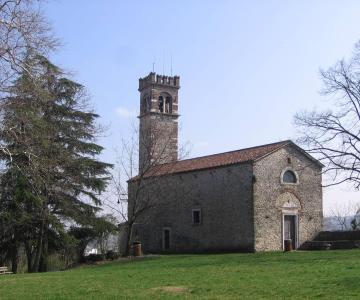
The church of San Giacomo dates back to the late 14th century, and its origin was determined by the foundation of a hospital by the confraternity of the Battuti.
At the beginning of the 14th century, there was already a small oratory, now the embryo of the current church, dedicated to Saints James and Christopher. The church was enlarged in the 15th century, equipping it with five altars and giving it the dimensions it has today. In the early years of the 17th century, the bell tower was raised, replacing the old sail-like one.
In 1806, the confraternity of the Battuti was suppressed, and the custody of the church was entrusted to a priest.
Subsequently, many transformations were carried out. In 1836, a new façade was built, and a general reorganization of the interiors took place in several phases (in 1845, 1861, and 1867), resulting in a reduction in the number of altars.
In 1896, the entire internal decorative apparatus was reformed, giving the church forms similar to those still visible today.
In 1949, the administration of the building passed to the parish of the cathedral.
In 1958, further internal works were carried out, leading to the elimination of two more altars to open access doors to the bell tower, the sacristy, and a window on the left side. Furthermore, armrests, confessionals, and the pulpit were removed.
In 2000, restoration work was carried out.
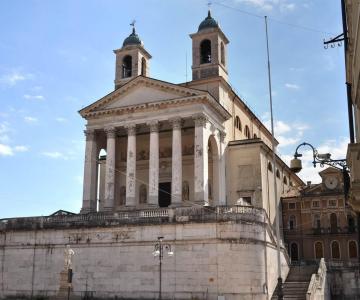
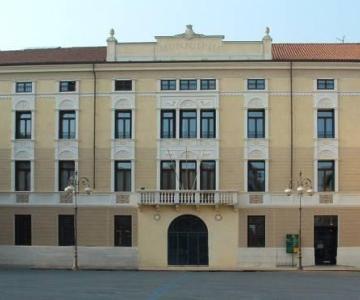
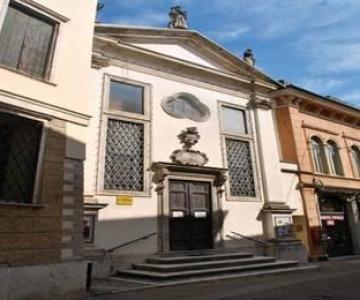
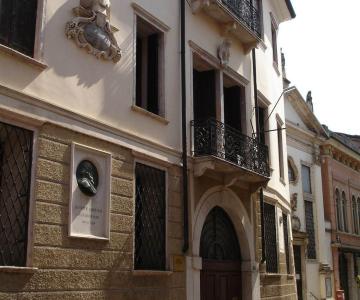
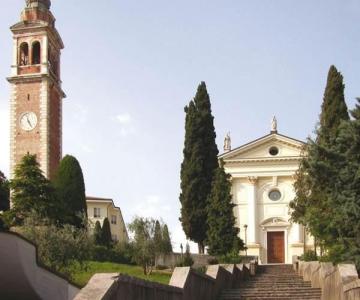
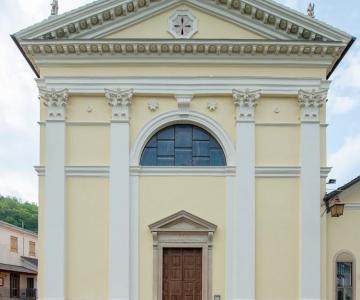
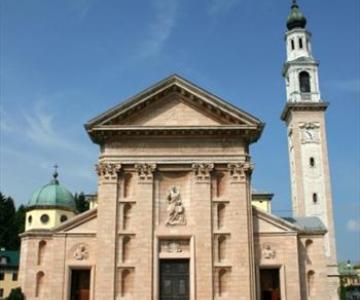
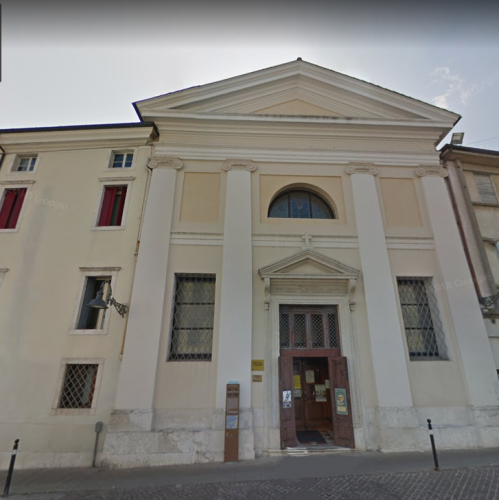
The neoclassical façade, resulting from the interventions of 1836, features a central door (topped by a tympanum), a semicircular window above the portal, two unframed windows, and ornaments on the sides.
The building is rhythmically divided by pilasters with Ionic capitals.
An inscription in the tympanum remembers the cholera epidemic of 1836.
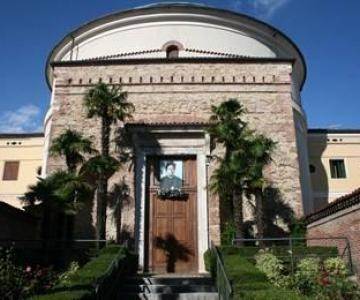
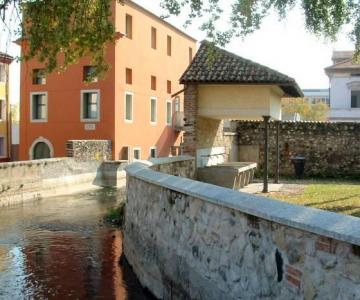
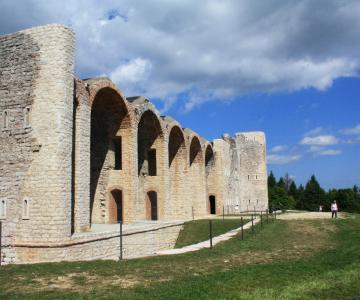
Through a door that opens to the right of the portico, one accesses the inner courtyard where one finds the bell tower from 1602, a tower made of brick and exposed stone, which holds two bells cast in 1925, and the 15th-century loggia of the Battuti, the only remaining part of the hospital complex founded by the confraternity, as well as the first seat of the Monte di Pietà scledense. The simple structure consists of a series of five full arches supported by columns on the ground floor and by simple little columns with a beam on the upper floor.
Inside, the church is structured in a rectangular hall ending with a small apse.
The decorative apparatus of the nave is the result of the interventions of 1896 carried out by Tommaso Pasquotti. His works also include the representations of The four evangelists, on the ceiling, (Saint Luke bears signs of interventions by Vittorio Pupin) and The three theological virtues (stereochromy by Valentino Pupin).
In the new marble floor, a mosaic with the logo of the jubilee of 2000 is incorporated; towards the presbytery, there is the tomb seal of the confraternity of the Battuti from the 17th century, brought to light in 1985. Its inscription: HIC / MISERA HUMANITATIS RESSIDUA / DONEC / AD IUDITIUM VOCENTUR / TRES CUM TREGINTA / HUIUS XENODOCHII CONFRATRES / SIBI SUCESSORIBUSQ(UE) / UT REQUIESCANT DECREVERE CONCORDES / AN(N)O D(OMI)NI / MDCLXXXVIII (translation: The thirty-three confreres of this xenodochium unanimously established [this tomb] for themselves and their successors so that here they may rest their miserable remains until they are called to judgment. In the year of the Lord 1688).
On the walls, there is a series of large representations of The seven sorrows of the Virgin, commissioned in 1867 from Valentino Pupin. Initially, they were to be stereochromies, but due to the humidity of the environment, the author changed the technique and used oil on canvas. The cycle of the Virgin's sorrows consists of: Presentation of Jesus at the Temple (oil on canvas, 1883), Flight into Egypt (oil on canvas, 1883), Dispute with the doctors (oil on canvas, 1879), Ascent to Calvary (oil and tempera on canvas, 1880), Crucifixion (stereochromy, 1868), Deposition from the Cross (tempera in casein repainted in oil, 1876 Valentino Pupin / 1898 Tommaso Pasquotti), Deposition of Jesus in the tomb (oil on canvas, 1882). The canvas of the Deposition from the Cross had been executed by Pupin and repainted by Pasquotti a few years later due to its poor state of preservation. Concluding the cycle of the Virgin's sorrows is an oil on canvas by Tommaso Pasquotti from 1900: Crowning of the Virgin. Other canvases present in the church include Saint James preaching the Gospel in Spain (1863, Valentino Pupin) originally placed on an altar dismantled in 1958, now hanging at the head of the nave, on the left; The Madonna of the Rosary (1851, Giuseppe Pupin) altarpiece placed at Saint James in 1958 at the head of the nave, on the right, as a complement to that of Valentino Pupin present in the opposite side; to the side, a large neo-Byzantine crucifix in plaster, the work of Napoleone Guizzon and Pietro Paolo Dalla Vecchia Jr. from 1896.
Finally, the ancient altarpiece Madonna with Child and Saints James, Blaise, Lawrence, and Christopher, now displayed above the lobby in the counter-facade, heavily altered and resized in the past to fit new placements: a 17th-century canvas once of the main altar of the church, attributed to the local painter Zambon Zamboni.
The only altar in the church is located in the small area of the presbytery, separated from the nave by a full arch.
It is a work from 1881 by Francesco Cavallini that reutilizes the finely inlaid marble front, the roundels, the Corinthian columns, and the statues from the previous 17th-century altar.
The niche holds the sculpture Sorrowful Virgin with Christ dead in her arms of probable 17th-century manufacture but heavily modified in 1907 by Romano Cremasco. The new ambon, made in 2000, in inlaid marble, is interesting, as it recalls the shapes and coloring of the altar. In the apse, some ogival arches can be seen: the only testimony of the church's Gothic origin, along with a small fragment of fresco from the 15th century discovered in 1958.