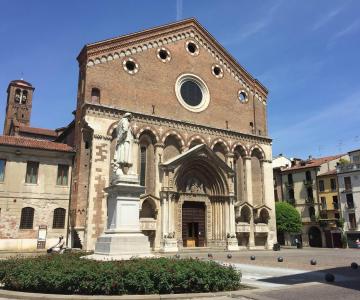
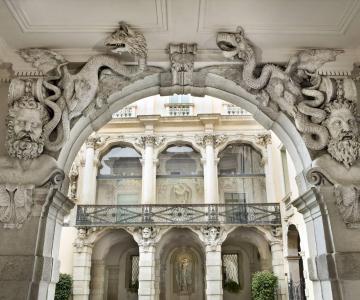
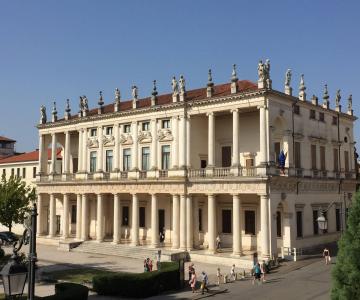
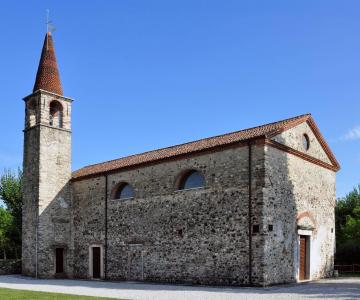
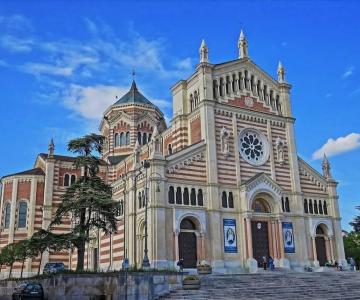
The Cathedral of Vicenza today appears as an impressive building with late Gothic forms, the result of a significant reconstruction following the bombings of 1944. However, the church has its roots in a Roman-era residential context served by a cobblestone-paved road.
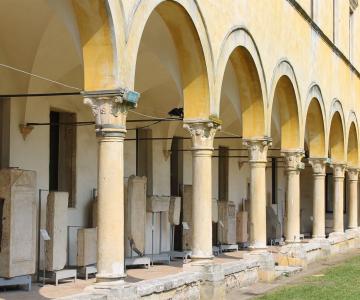
The Cathedral indeed develops from the structures of a private residence (1st century BC), transformed into a domus ecclesiae in the 3rd century, on which a paleochristian basilica was subsequently established, enlarged in the Carolingian era and rebuilt in the 12th century probably following the terrible earthquake of 1117.
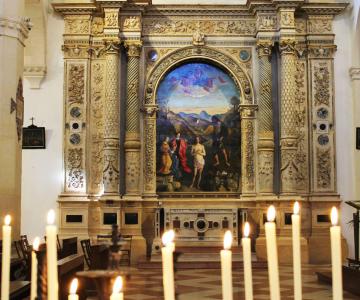
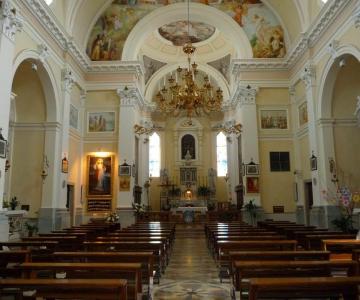
Inside, the church features a single nave, divided into five bays with ribbed vaults on poly-styled pillars attached to the walls where chapels open up, created between the 14th and 16th centuries, thanks to testamentary bequests from noble Vicentine families or also due to the initiative of some brotherhoods.
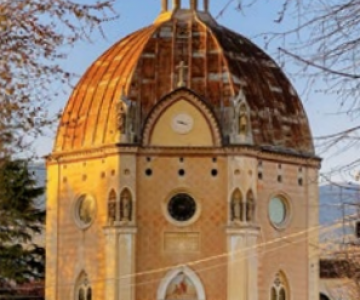
At the end, the main chapel, polygonal in shape, connects to the crypt and concludes with the dome of 1574 designed by the famous Andrea Palladio. The presbyterial area hosts at its center the precious Dall’Acqua altar, made of polychrome marbles, while sumptuous Civran Hanging decorates the walls, created between 1675-1682, adorned with twelve large paintings by some of the protagonists of the "tenebrosi" movement. In the side chapels, of particular significance, the polyptych with Dormitio Virginis by Lorenzo Veneziano from 1366, the chapel of Santa Caterina with the altarpiece by Bartolomeo Montagna depicting the Madonna with Child on the throne between Saints Mary Magdalene and Lucia, the stone altarpiece by Antonino da Venezia with the Coronation of the Virgin (1448), and the Chapel of the Blessed Sacrament with the cycle of the Passion (1587-1589) by Alessandro Maganza.
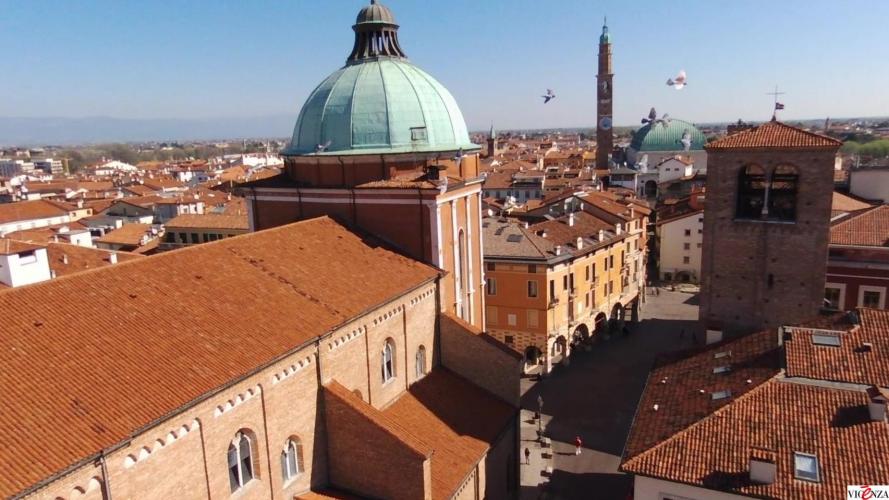
Cattedrale di santa Maria Annunciata
Corso Padova 76 , Vicenza - 36100
- Contacts
- Cattedrale di Santa Maria Annunciata
- tel. +39 0444 325007
- email diocesi@vicenza.chiesacattolica.it
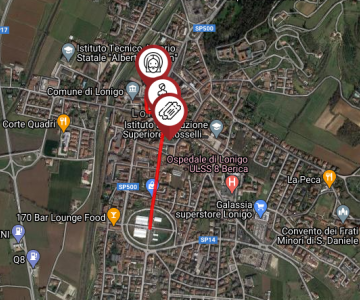
TAKE ME HERE: Corso Padova 76