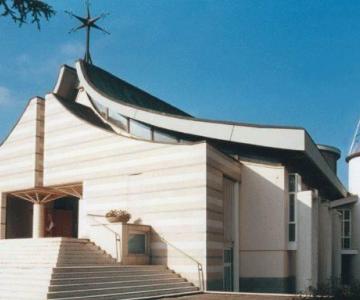
It was built at the request of Don Florindo Lucatello, Archpriest of Trissino, on the occasion of the Second Vatican Council, according to the design of Architect Antonio Nervi and Engineer Francesco Vacchini. Thus, the need expressed by the population for a larger and more accessible church was met.
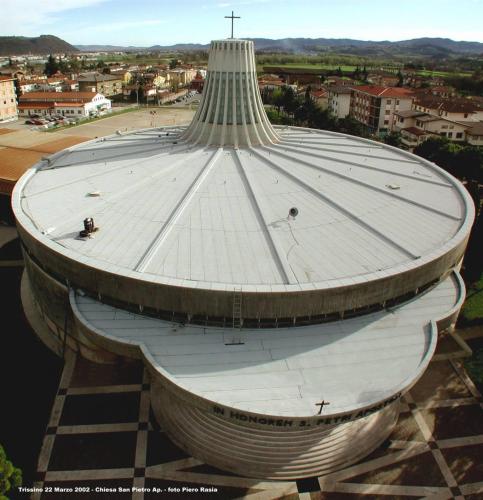
The work was inaugurated in 1971. The church is a cavea with a circular plan; it has a diameter of 50 meters and is covered by a single reinforced concrete dome, divided and decorated inside by ribbed elements that geometrically intersect. This roof is supported by two ribbed columns that widen from the bottom to the top, expanding and almost merging with the ceiling, integrating into its design.
A third support point is an architectural system within the cavea that delineates the presbytery; this consists of three simple columns, connected by a circular wall; they support three parabolic arches, from which an elegant conical dome rises upward. The floor is articulated into three different zones: a high area that surrounds the cavea and provides spaciousness to the whole; here, two chapels open up and the baptismal font is located; the cavea proper, where the seats of the Vatican Council are arranged as pews for the faithful; and the lower part, which includes the presbytery, the main altar, and the choir, separated from the assembly of the faithful, yet united with it.
Brightness, airiness, and lightness are provided by a window that runs along the entire high wall of the church's perimeter and by a series of rectangular openings that appear to give transparency and light to the conical "spire".
Among the artists who contributed to the essential works of art included in the Church are: Pino Castagna from Garda for the Christ who dominates the presbytery, Giuseppe Lombardi from Rome for the statue of the Madonna, Tito Perlotto from Trissino for the two embossed copper figures, Cantù from Milan for the mosaics of the chapels and the Baptismal Font, Simon Benetton from Treviso for the wrought iron of the main altar and the balustrades, Mario Ferrari and the company Rancan Remigio and sons from Trissino for the large wrought iron entrance doors, Aligi Sassu for the Stations of the Cross (1984).
The Church is a masterpiece of contemporary art and is a constant destination for Italian and foreign visitors.
Chiesa di San Pietro
Piazza G.G.TRISSINO 3 , Trissino - 36070
- Contacts
TAKE ME HERE: Piazza G.G.TRISSINO 3