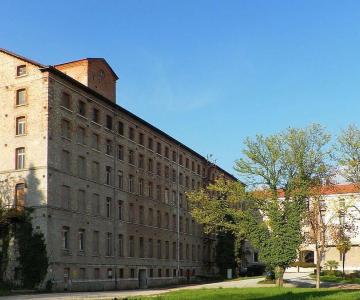
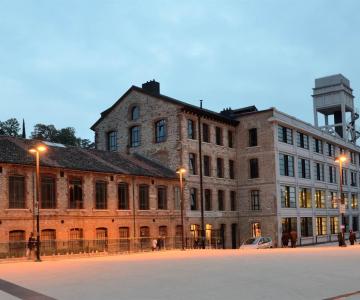
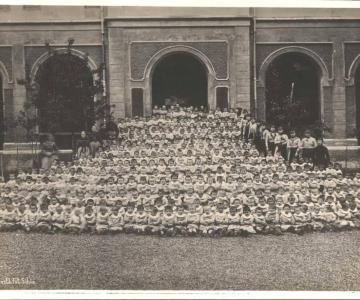
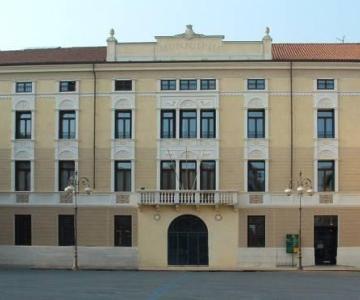
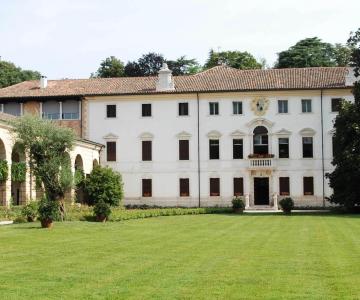
The Cazzola wool mill is located in the western part of the City, on the edges of the working-class Rossiano district, and it extends along the course of the Roggia Maestra, which defines its northern boundary. The factory was erected in 1860 by Pietro Cazzola and expanded by his son Luigi (1846-1932). The complex underwent, like many other local production structures, considerable expansions and technological innovations at the end of the nineteenth century and during the Giolittian era, while maintaining particular and consistent attention to respecting the original construction features. Overall, the wool mill has an area of over 30,000 square meters, more than half of which is covered; in fact, it extends horizontally with three two-story wings that overlook the internal courtyard where the bust of Pietro Cazzola has been placed in the center. The large production facility, made of exposed brick and stone, features a characteristic and pleasant low facade with two rows of large windows. The central entrance is simple, with a nice balcony above it featuring a clock and a gabled roof. The wool mill primarily produced carded fabrics and employed about a hundred people. A curious historical memory is associated with the Cazzola Wool Mill: during World War I, due to Schio's proximity to the front, part of the textile production activity was transferred to the Monza area, making way for the American Red Cross, whose headquarters took residence in the designer's room, while a dormitory was created in the napping room; part of the fourth section of the American Red Cross was Ernest Hemingway, the famous American writer. From his brief stay in Schio in June of 1918, he drew inspiration for many of his works, first and foremost “A Farewell to Arms.” The wool mill is now the subject of recent restoration and reuse for residential purposes.
Photo: archive of the Municipality of Schio.