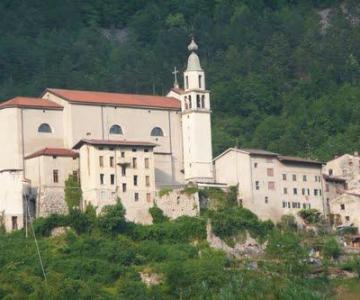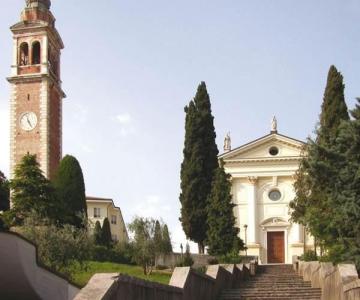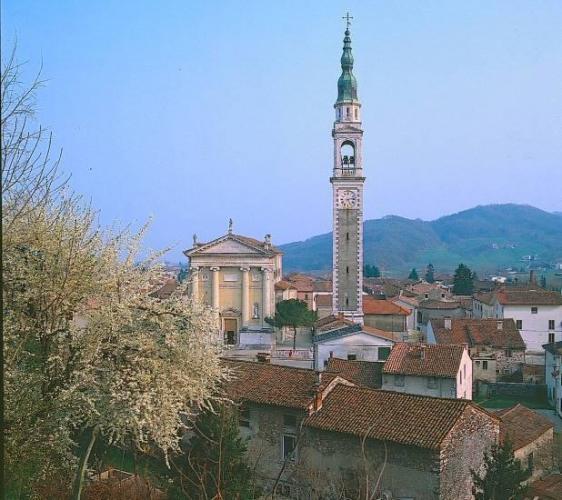
The church of Saints Leonzio and Carpoforo is the church of the town of Magrè.
It is the result of various reconstructions due to the increase of the population over time.
The first church dates back to the 11th or 12th centuries and was located, with the attached cemetery, on the slopes of Mount Raga.
Subsequently, due to the increase in population and the movement of the town center towards the plain, another building, larger, dedicated to Saint Benedict, was built. Constructed in the early years of the 15th century and although it was never made a parish seat (the title remained with the old church of the cemetery), it effectively became the main church of Magrè.
In the early 1800s, the church of Saint Benedict also became insufficient for the population, so it was demolished and replaced with another larger one not far away.
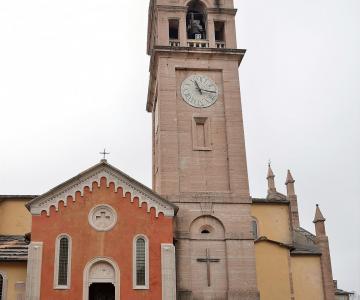
The new church, possibly designed by engineer Antonio Breganze, was completed in 1854 and dedicated to Saints Leonzio and Carpoforo, like the ancient church of the cemetery which was then destroyed during the Second World War. In the same year it was consecrated and erected as the parish seat of Magrè. Inside, an inscription commemorates the consecration: ILL(USRISSIMUS) AC REV(ERENDISSIMUS) D(OMINUS) D(OMINUS) ANTONIUS FARINA TARVISNUS PRO EPIS(COPO) VICEN(ENTINO) IO(ANNE) IOS(EPH) CAPPELLARI ECCL(ESIAM) HANC SOLEM(N) DEDICAVIT X KAL(ENDAS) NOVEMBRIS MDCCCLIV (translation:The Most Illustrious and Most Reverend Monsignor Antonio Farina, Bishop of Treviso, dedicated this church solemnly for the Bishop of Vicenza Giovanni Giuseppe Cappellari on October 23, 1854. In 1911, the construction of the bell tower designed by engineer Giovanni Battista Saccardo was completed).
In the 1980s, the church underwent further important restoration.
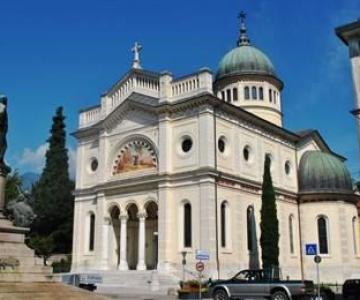
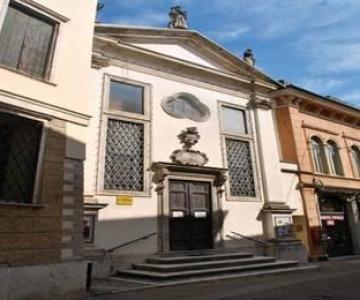
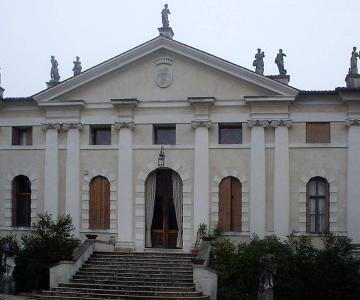
The facade has a neoclassical style, typical of the 19th century. Above a high pedestal rise four Ionic half-columns supporting a pediment crowned with statues from the church of Saint Benedict. Between the columns are two niches containing other statues dedicated by the church's patrons, and in the center is the portal crowned by a pediment.
At the top, above a string course, two bas-reliefs are distinguished on the sides and a dedication plaque in the center.
On the right facade of the building is a sundial made during the restorations of the 1980s.
Inside, it consists of a single nave rhythmically divided by Ionic pilasters.
The upper part is decorated with eight high reliefs in stone, created by Angelo Gresele in 1939/40, depicting episodes from the Old and New Testament. Housed in the tribunes from the church of Saint Benedict are the sculptures of four angels. The ancient church also had the holy water font from the 17th century, as well as the altars that adorn the side walls: on the left the altar of Saint Joseph and the Immaculate, on the right the one dedicated to Saint Anthony the Abbot and the Sacred Heart of Jesus.
On the ceiling is preserved the painting of the Apotheosis of Saints Leonzio and Carpoforo, a work from 1897 by Alberto Boschetti. On the left wall is the canvas Saint Zeno in contemplation of the Madonna, coming from another place of worship in Magrè and perhaps attributable to Costantino Pasqualotto and the ancient baptismal font in stone from the 11th century coming from the ancient church of Saints Leonzio and Carpoforo, destroyed in 1945.
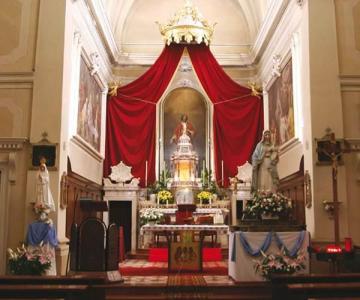
To separate the nave from the presbytery, where the main altar is located, there is a short staircase.
The altar has been constructed using parts from Saint Benedict. The presbytery area is adorned with paintings by Giuseppe Pupin dating back to 1862: Martyrdom of Saints Leonzio and Carpoforo, the Evangelists, and God the Father; and by Giuseppe Faccin: Jesus with the children and The Last Supper. On the left, you can access the small room of the Eucharistic Chapel: the ceiling is decorated with a fresco by Giuseppe Pupin depicting Christ surrounded by children inside an oval. The altar, made by recovering parts of the old altar of Saint Benedict, maintains a antependium from the 16th century by an anonymous author coming from the church of Saint Zeno in Magrè.
Photo: archive of the Municipality of Schio.