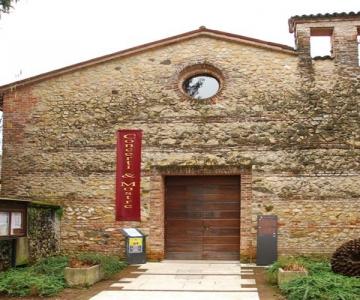
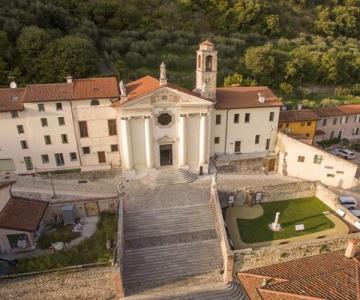
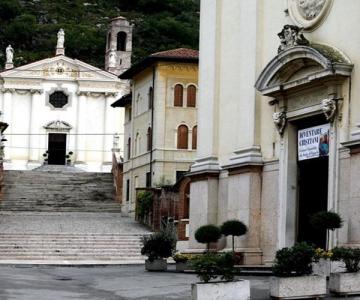
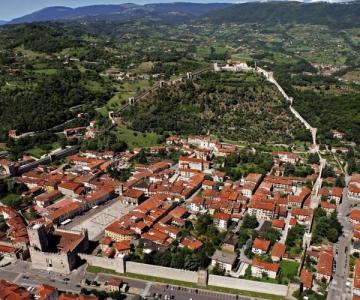
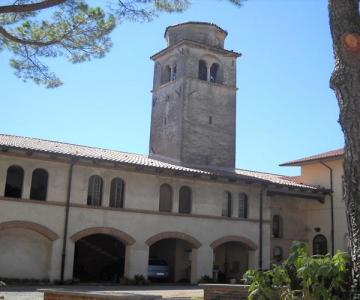
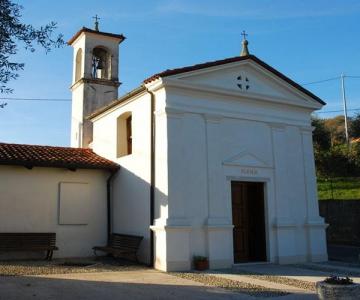
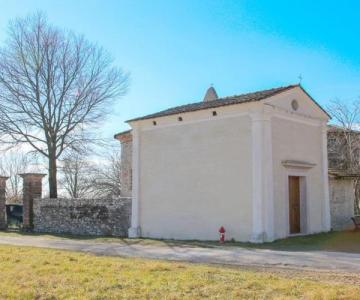
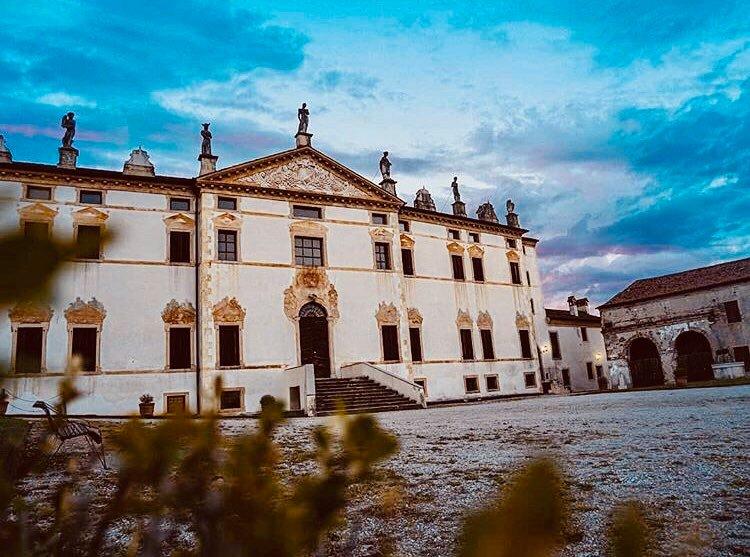
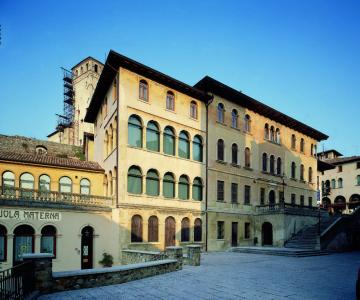
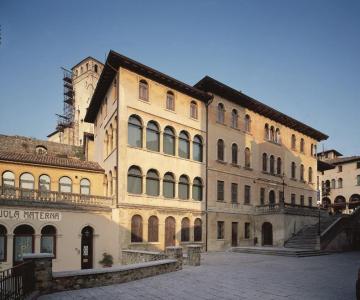
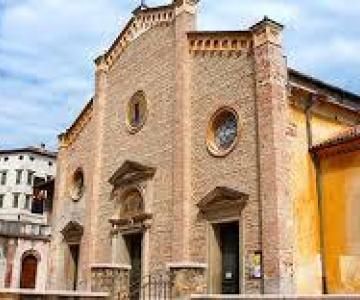
It is the oldest testimony of Christian faith in Marostica. Baptismal church of the area, dating back in all probability to the Early Middle Ages, it became the parish church of the first settlement nucleus of Marostica (the Pieve-Giara village) at the foot of the Pauso, a place of ancient human habitation in pre-Roman and Roman times. Center for the spread of the evangelical message, in the 13th century it was an archipresbyterian church, on which numerous branch churches scattered throughout the area depended. It was the subject of a radical reconstruction and expansion intervention in the last years of the seventeenth century thanks to the enterprising Don Gaspare Ghirardelli (an inscription inside indicates the exact point where the old church reached and the beginning of the new construction part). It was consecrated in 1701. Thanks to this innovative intervention it took on its current configuration with a baroque façade. Of great artistic interest are the three doors with bronze panels, which date back to 1979-1985, which tell biblical episodes and the life of Christ, the work of the Marostican artist Gigi Carron (1926-2006). The bell tower, built in 1711, was enriched by a valuable sundial and a clock, which dates back to 1727, which is due to the mastery of the famous Bartolomeo Ferracina.
Interiors
The three naves date back to the reconstruction work at the end of the seventeenth century. The church is equipped with eight altars. The Major one, in Baroque style and from the school of Marinali (17th century), was once embellished, according to Giovanni Battista Verci, by a painting by Alessandro Maganza, now replaced by a copy of Titian's Assumption, the work of the painter Giuseppe Fortunato Centazzo (19th century). Of considerable interest, also in the apse, is the canvas by Andrea Celesti (circa 1637-1711) depicting the Sacrifice of Melchizedek. The frontals of the altars of Our Lady of Sorrows and Our Lady of Lourdes are of fine workmanship. The frescoes in the three compartments of the ceiling are by Bartolomeo Dusi (1833-1904), also the author of the Transfiguration on the vault of the apse. The canvas Christ in the Garden is by Pietro Menegatti (1809-1848) and the Baptism of Christ by friar Felice Cignaroli. Once outside the church (north side), now placed in the north wall of the left side nave, is the marble relief depicting the Madonna with Child Jesus, from the Sansovino school, an ex-voto donated by Prospero Alpini (1553 -1616), as thanks for returning from the trip to Egypt.