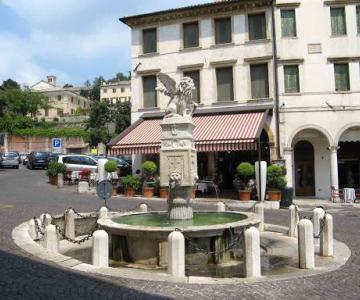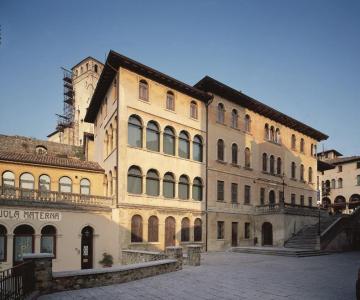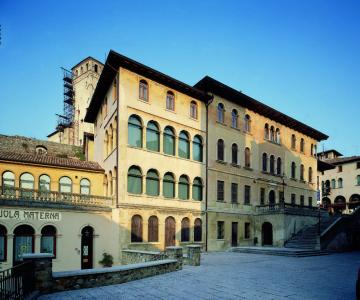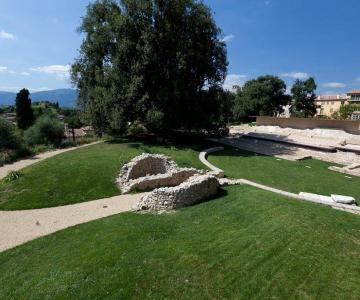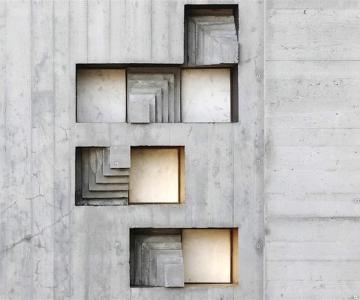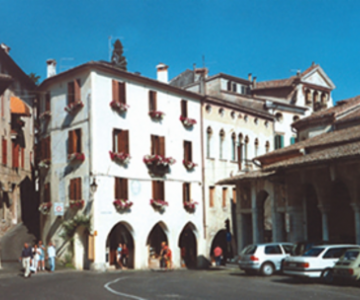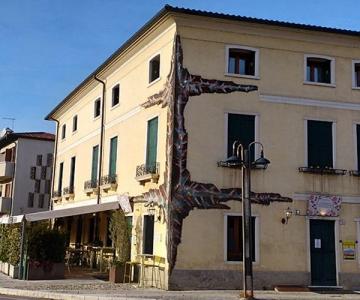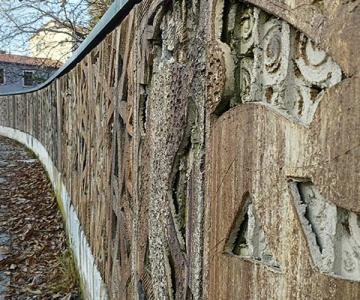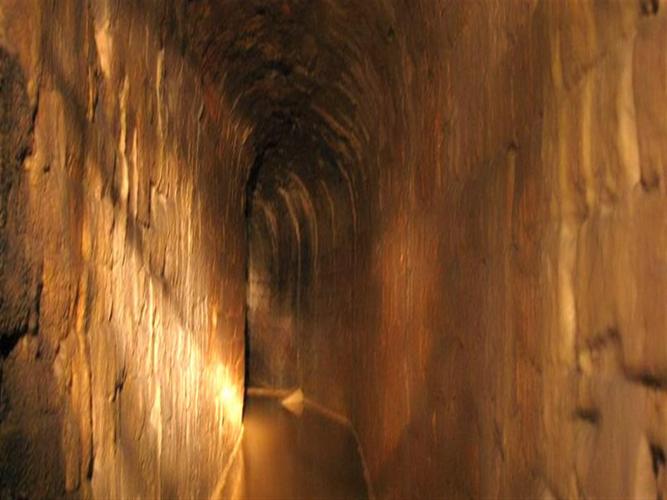

The aqueduct, functionally linked to the Roman baths for which it ensured the water supply, developed along a total route of about 600-700 meters from the water intake of the "Tintina" spring (near the northern slope of Montericco) to the town square, where the thermal building was located. From the spring to approximately the medieval gate known as "Pusterla del Colmarion," the water was carried by a system of lead pipes, some of which were discovered in the 1800s by the scholar Pacifico Scomazzetto. From this point, where another ancient spring also flowed, the aqueduct developed into a tunnel excavated in the “Montericco” for about 157 meters. The distribution of water to the thermal building likely occurred directly through pipes found in the past several times in the final section of the hydraulic work, right near the current exit in Piazza Brugnoli. The Roman tunnel (averaging 50 centimeters in width and 1 to 2 meters in height) features at least four different lining techniques that are connected to the varying geological matrix of the ground encountered along the way. The original hydraulic system can be traced back to the 1st century AD. In perhaps medieval times, the Roman aqueduct became part of a more complex hydraulic system due to the construction, in the northern section, of an overlapping gallery, which follows the path of the older structure, called “Cava” or “Cava delle Monache” (due to its proximity to the Monastery of San Luigi or San Pietro). The first restoration interventions on the structure date back to the early 1800s, but it was only in 1918 that architect Léon Gurekian documented and analyzed the structure as a historical document and with the report of the “Commission for the protection of Monuments and Landscapes of Asolo” in 1922, he obtained, in 1923, the monument's protection status. Since that date, the “Bot” has once again fallen into oblivion; the “Cava” was used as a storage cellar and, during the last conflict, as an air raid shelter.
Only in the last ten years has the hydraulic work been the subject of a specific study and a complete graphic reconstruction.