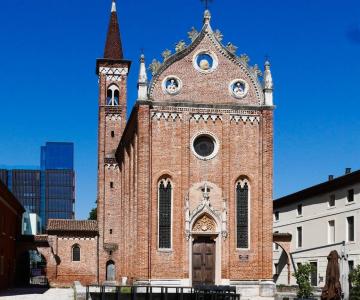
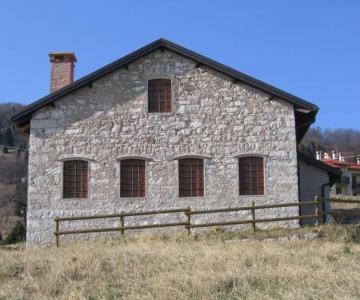
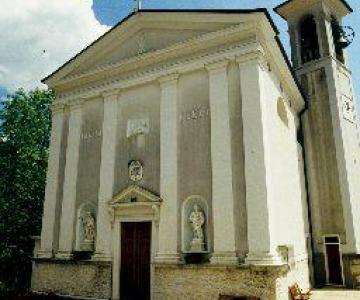
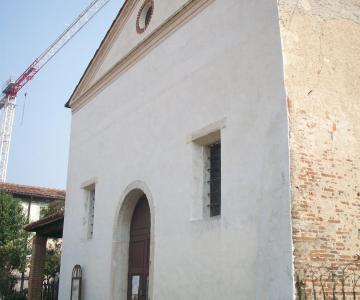
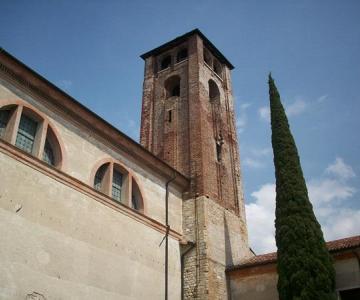
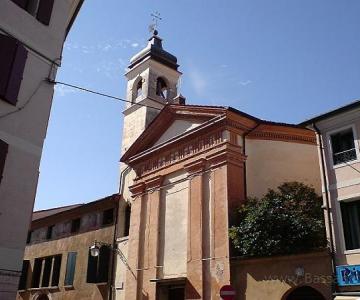
The church, the oldest religious building in Thiene, was built in 1333 at the behest of the three brothers Miglioranza, Uguccione, and Marco Thiene who dedicated it to their father Vincenzo.
The building, with its sober Romanesque-Gothic lines and rectangular plan, has undergone a series of modifications over the centuries. The construction of the presbytery, not aligned with the nave, would have taken place in the last decades of the 14th century, while the raising of the roof and the opening of the oculus in the facade should date back to the 16th century.
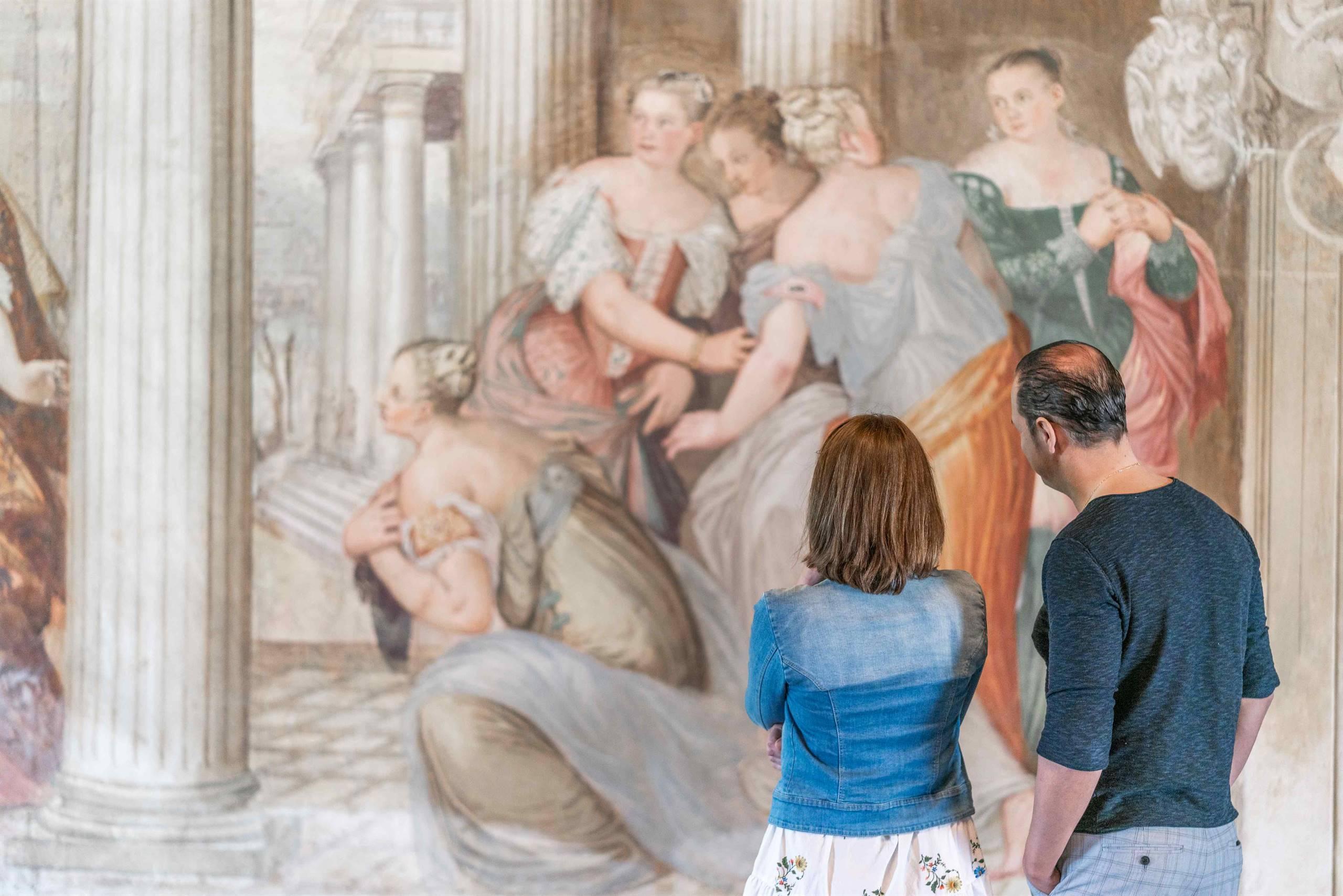
Inside the church, the frescoes that decorate the walls of the nave and the presbytery are believed to have been created between the 14th and 16th centuries.
On the right wall of the nave stands out, in particular, a grouping of five saints among whom it is possible to distinctly identify Saint Leonard, holding the handcuffs, his specific attribute. The fresco is thought to date back to the mid-14th century and should be contemporary with the construction of the church. The oldest frescoes show Giottesque influence and, for these decorations, scholars have proposed the names of Maestro di San Lorenzo (who had already executed frescoes for the Thiene family) or of Nicolò and Marco from Venice (respectively father and son, with Marco documented as living in Thiene between 1343-1346).
The decoration of the presbytery walls is divided into two bands: the lower one depicts the Apostles; in the upper one, the side lunette frescoes illustrate the Stories of the life of Saint Vincent and a Nativity of the shepherds, partially ruined due to the opening of a window. The vault of the presbytery is decorated with the Symbols of the four Evangelists and a Blessing Christ placed in the center.
It has been hypothesized by scholars that these frescoes were created by a follower of Michelino da Besozzo (Apostles and Symbols of the four Evangelists) and by Giovanni Badile (Stories of the life of Saint Vincent and Nativity of the shepherds), artists active in Verona.
The main altar, made in the 17th century, houses the painting by Alessandro Maganza depicting the Madonna enthroned between Saints Vincent and Anastasius (1613), with Saint Vincent offering the Virgin a silver model of the city of Vicenza. The work is surrounded by stucco statues of Saint John the Baptist and Saint Francis. The construction of the entire structure has concealed part of the 15th-century frescoes that decorated the back wall of the presbytery.