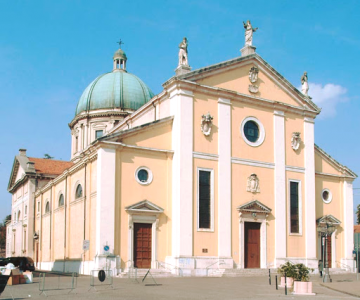
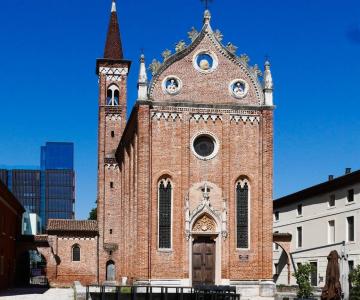
The Church of the Rosary, located near the Cathedral, was originally dedicated to Saint Martin. It was only at the end of the sixteenth century, after the naval battle of Lepanto (October 7, 1571), that it was dedicated to Our Lady of the Rosary.
The church, which already existed in 1418, is linked to the presence of Confraternities, which were established in the Middle Ages and multiplied after the Council of Trent (1545-1563), having chosen it as a place of worship and gathering. Originally, it consisted of a single nave, the presbytery, and two chapels of the confraternities, added towards the end of the fifteenth century, giving the plant the shape of a Latin cross. Between 1675 and 1699, the internal spaces were reorganized, and the church began to have its own decor.
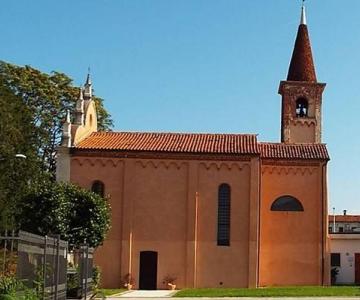
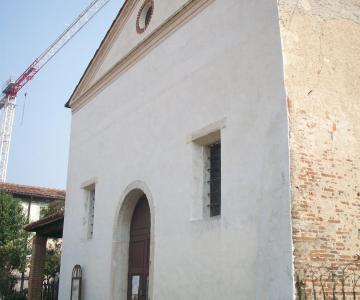
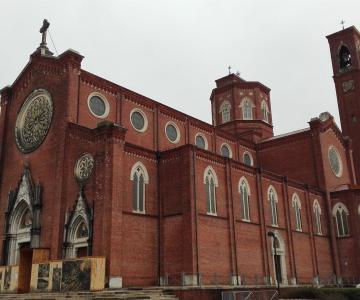
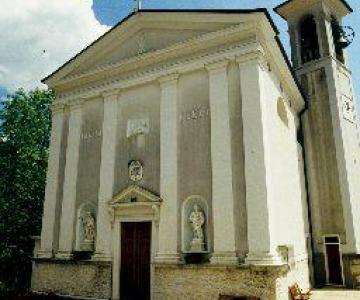
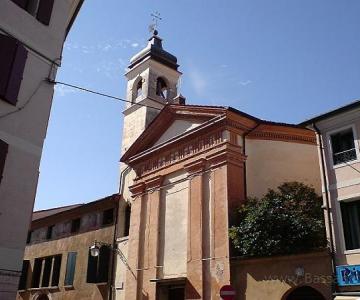
In 1911, following the expansion works of the Cathedral which saw the realization of the square in front and Via Roma, new interventions involved the Church of the Rosary: the portico that connected it to the adjacent Church of the Holy Trinity (or of the Carmine) was demolished; thus, the bare façade appeared, which the Thiene architect Carlo Pasinati recomposed in Baroque forms, as we see it today.
The interior of the church features three naves divided by arches resting on pairs of marble columns and Ionic capitals: the central nave is covered by a simple vault and decorated with frames and pilasters with four paintings of the Evangelists, while the side naves are divided into three bays each with ceilings decorated with frescoes and Baroque stuccoes. The flooring, redone in 1783, consists of squares of red and white marble from Asiago.
The presbytery is adorned with wonderful Baroque stuccoes by unknown authors: scrolls, curls, cartouches, festoons, cornucopias, drapes, floral motifs, and charming cherubs and restless angels frame paintings and frescoes. On the splendid and majestic Baroque altar made of polychrome marbles (completed in 1769) is embedded the altar piece, dated 1590 and signed by the Paduan painter Matteo Grazioli, depicting the Madonna of the Holy Rosary between Saint Dominic and Saint Catherine of Siena, surrounded by 15 panels representing the Mysteries of the Rosary.
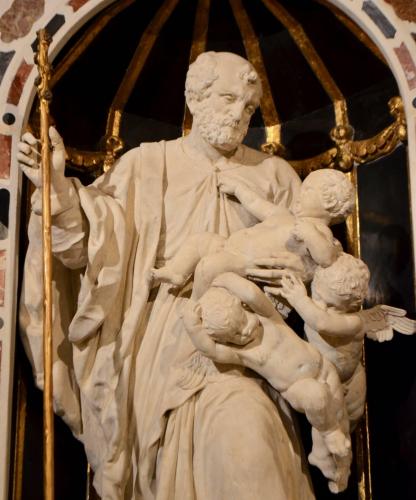
The church is also adorned by a precious statue depicting Saint Joseph with the Child and cherubs. The sculpture embellishes the last altar of the right nave and is attributed to Orazio Marinali, an exceptionally skilled sculptor from Bassano, who is believed to have created it in 1690.


Chiesa del Rosario
Via Roma 42 , Thiene - 36016
- Contacts
TAKE ME HERE: Via Roma 42