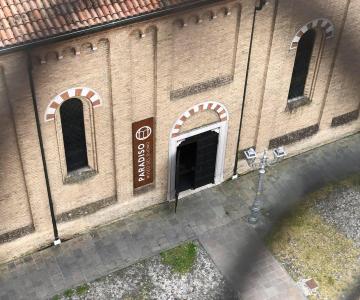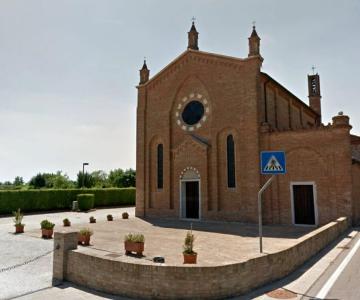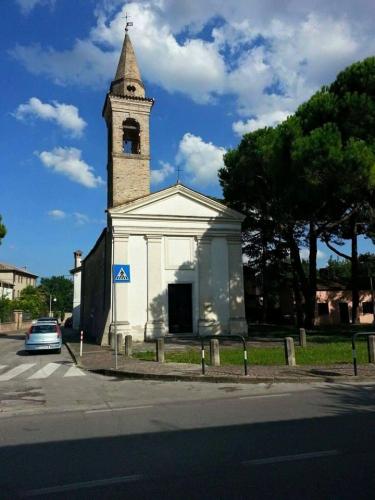


Architecturally, it is interesting to note the considerable thickness of the walls (50 cm), which are without foundations and built not only with bricks, but also with pebbles and salvaged materials from which the uneven course of the walls derives, as can be clearly seen on the outer left wall.
The somewhat unusual choice of materials and the "roughness" of the masonry is well justified by the history of the foundation of the church of San Nicolò by the boatmen and fishermen of Piove di Sacco following the passage of their previous church.
By the mid-14th century it was in contact with a monastery dependent on Santa Maria della Carità in Venice, and a father of this confraternity was officiating in the 16th century, but it was governed by the cathedral.
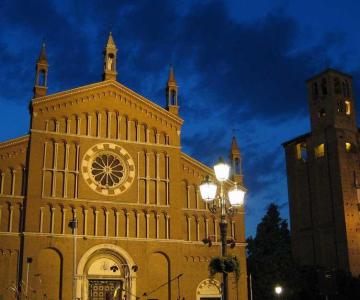
The exterior is now in face stone, except for the facade, which is plastered and finished in marmorino, with pilasters and gable and can be dated to the 16th century.
The interior, restored to its medieval appearance by restorations conducted during the 1950s-60s, has a hall plan ending in a semicircular apse and a gabled roof.
Noteworthy is the contribution of Guglielmo Veneziano to whom we owe the Polyptych of the Virgin and Child with Saints Martin, John the Baptist, Nicholas and Francis signed and dated around 1360; the two figures (St. John the Baptist and St. Anthony the Abbot) frescoed in the upper part of the left wall as well as the St. John the Baptist and Mary Magdalene on the opposite wall.
Instead, they are to be considered ex-votos from different periods and wanted by the devotees of the district the various panels depicting Madonnas with Child, figures of Saints or the Angel Weighing the Souls, dated 1426, on the left wall near the bell tower.
Among the various images is perhaps identifiable with the Patron of this site the figure on the right side of the triumphal arch of which can still be admired the rich decoration of the drapery.
Finally, the decoration still preserved today concludes chronologically with the Annunciation fresco above the archway, a work dating from 1645, as testifies the cartouche on the impost of the arch; while the eighteenth-century altarpieces by Tiepolo, documented in the 19th century in this building, are now preserved in the cathedral.
The church can be visited by guided tour and by reservation.