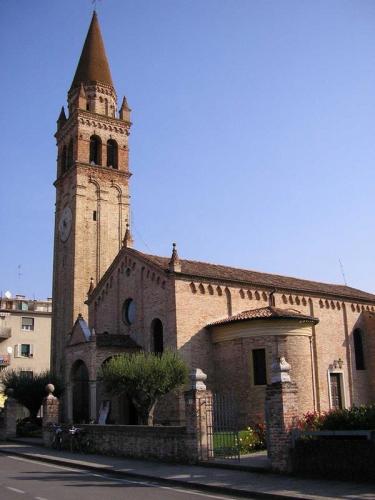

The oldest documents mentioning it date back to the 12th century, but it is believed that the building existed at least since the Early Middle Ages and that the original structure was paleochristian.
The current church is Romanesque, although with significant Gothic influences, and retains in its basic lines the appearance dating back to the 13th century, despite the numerous renovations and expansions carried out over the centuries.
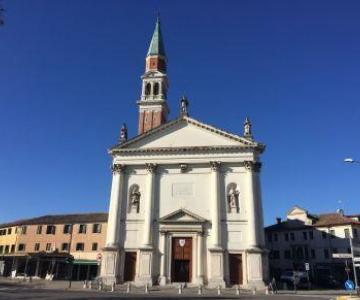
The façade is very simple and elegant, clad in terracotta tiles from Treviso and adorned with an external portico supported by two stone columns; beneath the portico, the lunette above the portal is decorated with a fresco depicting Saint Martin dividing his cloak with the poor man.
Inside, on the walls, there are still remnants of a 16th-century fresco that once completely adorned them; today only an image of Saint Lucia remains discernible. The chapel of the baptismal font, dating back to the 17th century and completely frescoed, features on its walls a cycle of stories of Saint Martin, dated 1608, while the ceiling is illustrated with a Glory of Paradise painted around the same years. The font itself is ancient, made of Greek marble, positioned on a pedestal of African marble; the metallic dome covering it is, however, a modern addition. The presbytery and the main altar date back to the late 17th century. Above the altar is a precious gilded polyptych attributed to the school of Giambellino; the work consists of eleven panels arranged over three tiers.
Outside the church stands the bell tower, clad, like the church, in terracotta tiles.